Get Full Government Meeting Transcripts, Videos, & Alerts Forever!
Get email alerts on the Signage topic
No spam. Unsubscribe anytime.
Design review panel approves illuminated sign for Oak and Poppy with lighting conditions
Summary
The City of Orange Design Review Committee approved a new illuminated wall sign for Oak and Poppy at 117 North Olive Street in the Old Town Historic District, subject to replacing four proposed gooseneck fixtures with two globe lights and allowing staff to finalize fixture placement and minor lettering adjustments.
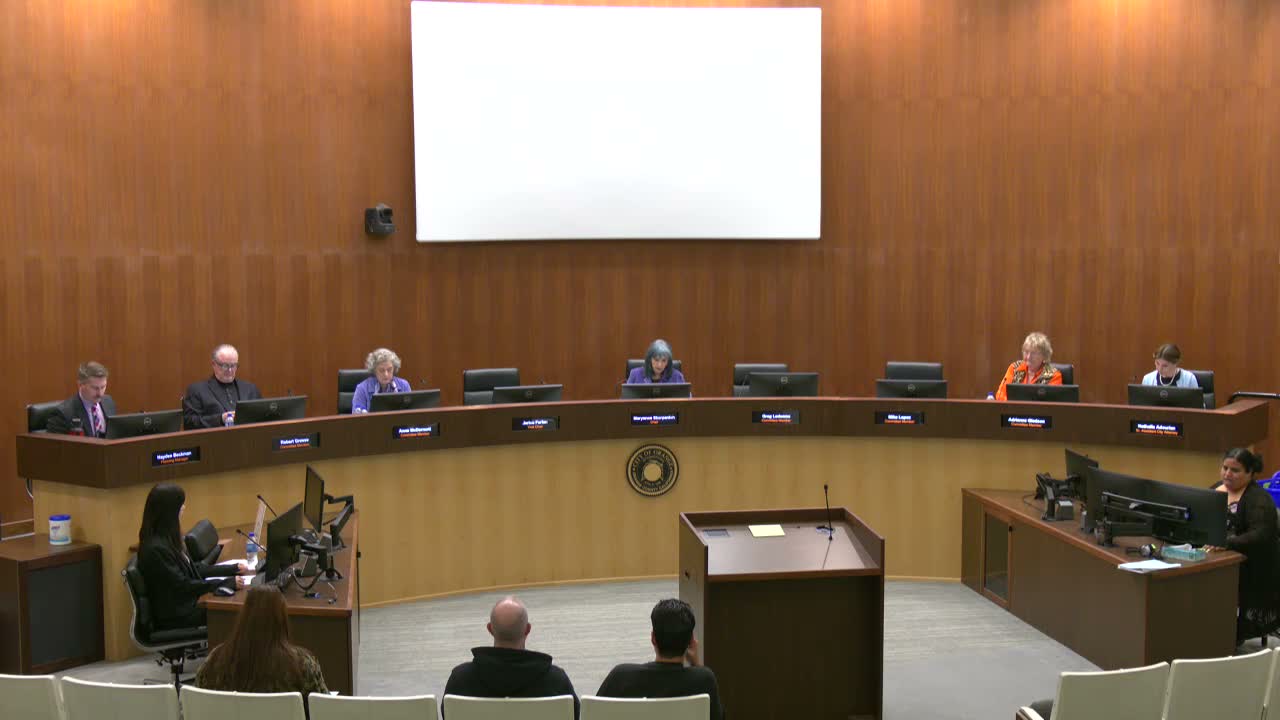
The City of Orange Design Review Committee voted unanimously to approve an illuminated wall sign for a new tenant, Oak and Poppy, at 117 North Olive Street in the Old Town Historic District.
In a staff presentation, planner Isherberger summarized the proposal and findings: the one‑story 1914 contributing building would receive a single aluminum wall sign measuring 18.7 inches high by 14 feet 1 inch wide (about 22.78 square feet), mounted roughly 10 feet 1 inch above grade and anchored into the stucco/plywood facade. The applicant proposed halo backlit letters with LED modules behind aluminum letters and a clear acrylic backing, plus four metal gooseneck fixtures; the lighting plan specified 3,000‑kelvin LEDs. Isherberger said staff found the size, placement, materials and lighting consistent with the Old Town historic preservation design standards, Orange municipal code and the Secretary of the Interior’s standards, and recommended approval.
The applicant, who described Oak and Poppy as a small business relocating to Old Town, said the street is “quite dark at night” and argued additional lighting would improve pedestrian safety and visibility for customers. “The street is so dark,” the applicant said, and added the team had not yet ordered fixtures and could adjust spacing or fixture type based on the Committee’s guidance.
Committee members pressed technical questions about ownership and historic fabric (the building is owned by the Masonic temple and has a stuccoed storefront) and raised design concerns about combining halo‑lit letters with close‑mounted gooseneck fixtures. One member said the close proximity of goosenecks could “wash out” the halo lettering and noted that the configuration was unusual in Old Town, citing nearby examples such as Black Dot and Bluestone Lane as contrasts in how lighting is used. Committee members suggested alternatives including inverting the placement (goosenecks below the letters), reducing the number of fixtures, or substituting two globe sconces to light the sidewalk rather than washing the facade.
After discussing tradeoffs between retail visibility and sidewalk illumination, the Committee moved to approve the application subject to the findings and conditions in the staff report and two additional conditions: that the four proposed goosenecks be replaced by two globe lights placed to the sides of the solid wall facade to illuminate the sidewalk and that the position of the lettering may be adjusted based on the applicants’ consultant and subject to final staff approval. The motion passed unanimously.
The Committee and staff framed the action as permitting the signage while giving staff the flexibility to work with the applicant on final fixture placement and spacing to address both legibility and public‑safety concerns. The applicant said they would be open to inverting fixtures or using two globes and thanked the Committee; members welcomed the new business to Old Town Orange.
The Committee closed the meeting after announcing its next regular meeting date.