Get Full Government Meeting Transcripts, Videos, & Alerts Forever!
Get email alerts on the Strategic Plan topic
No spam. Unsubscribe anytime.
Santiago Creek Commission approves revised strategic plan, sends it to City Council with staff edits
Summary
The Santiago Creek Commission unanimously approved a revised Santiago Creek strategic plan 7–0 on Jan. 28, 2026, directing staff to make specified editorial and technical edits before the plan is presented to City Council; the plan emphasizes habitat restoration, trail branding and public safety and documents new conservation dedications at the Sully/Sally Miller site.
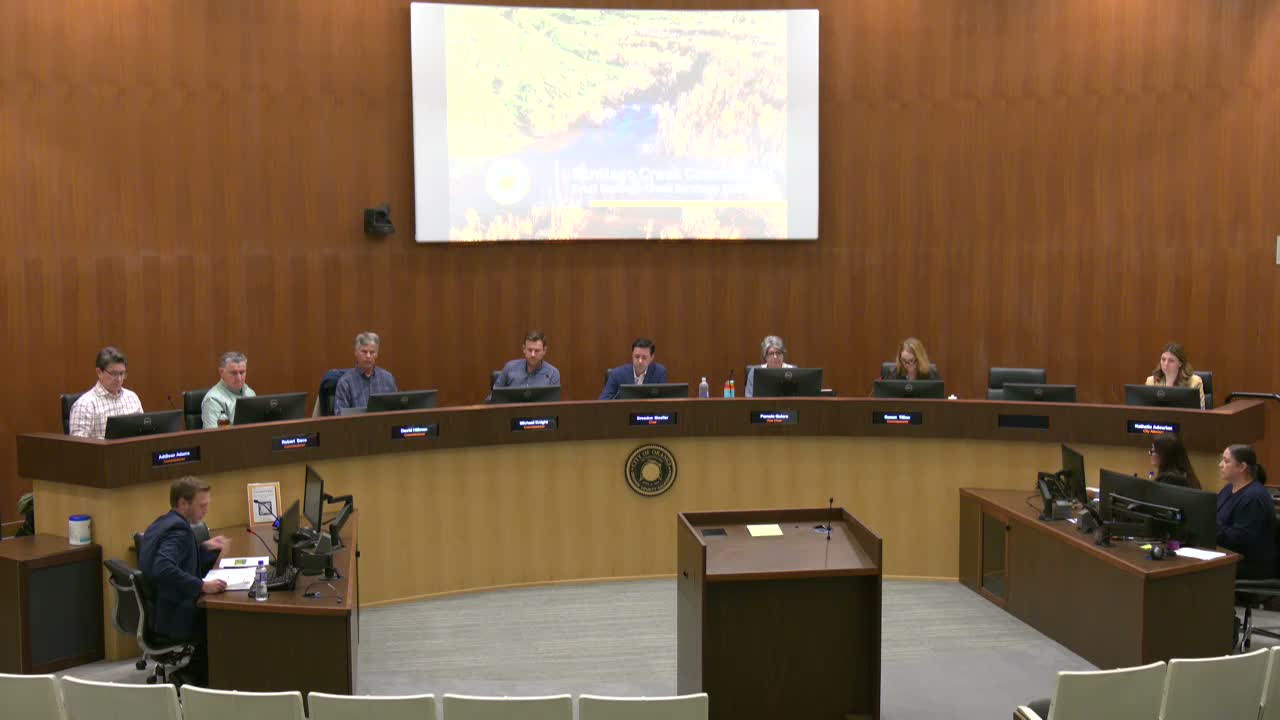
The Santiago Creek Commission voted unanimously, 7–0, on Jan. 28 to approve a revised Santiago Creek strategic plan and forward it to the City Council with staff-directed edits. The commission asked staff to add document dates and links, refine vocabulary, insert an executive summary, and clarify that any on-the-ground habitat-restoration work must be preceded by scientific studies and biological assessments.
City planning staffer Jack told the commission the revision incorporates months of commission direction and public comments, adds parcel-ownership and regional maps, and emphasizes three cross-cutting priorities: habitat restoration, trail branding and public safety. "We tried to capture as much of that," Jack said during the presentation, noting maps that range from the Santa Ana River watershed down to the Santiago Creek corridor within the City of Orange.
Public commenters urged sharper ecological guidance and careful pre-restoration study. "This is called the Santiago Creek Greenbelt — it's not a greenway," Teresa Sears said, urging consistent naming that aligns with underlying land-use plans and grant applications. Jensen Hallstrom asked for a tighter definition of "natural vegetation" that prioritizes locally native species from the Santiago Creek watershed. Joel Robinson urged a comprehensive biological and cultural resources assessment to document plant and animal species before restoration work, warning that seasonal variation and hidden species can be missed without proper surveys.
Commissioners flagged a handful of specific edits. Vice Chair Galera recommended removing phrasing that conflates bikeways with pedestrians and asked that the plan show existing and proposed bike paths on the maps. The commission agreed to remove language about "duck feeding stations" and instead favor educational signage and habitat education. Several members asked for "ecological" to be added to the vision and values language and requested links to historical research and source maps in an appendix.
The plan notes a recent land dedication near the Sully/Sally Miller site: the commission heard that 30.7575 acres were dedicated to the City of Orange for open-space purposes, with approximately 2.3 acres placed under conservation easement and management agreements naming Rivers and Lands Conservancy and the California Department of Fish and Wildlife as easement holders; staff said IRC will manage portions of conserved lands. Staff also said the Santa Ana Watershed Association completed a biological assessment of selected locations; that report will be shared with commission staff for inclusion in planning and grant work.
Staff will incorporate the edits read back at the meeting — including adding dates and links to background documents, inserting an executive summary, clarifying the land-acknowledgement language, and preface habitat-restoration actions with required scientific studies — before the plan packet goes to City Council. The commission’s motion to approve the draft subject to those changes was moved by Commissioner Tolle, seconded by Commissioner Knight, and passed 7–0.
The commission also discussed implementation pathways and the need for council direction before creating subcommittees with expanded scope; the city attorney advised that council approval should precede any formal scope expansion. The staff report will note collaboration opportunities with public works, community services, local nonprofits and the city’s recently approved three-year agreement with Townsend Public Affairs for legislative advocacy and grant writing.
The commission’s approval sends the revised strategic plan to the City Council for review and possible adoption; staff did not set a council date at the meeting but said they planned to present the document for council consideration in February pending final edits.