Get Full Government Meeting Transcripts, Videos, & Alerts Forever!
Get email alerts on the Housing Development topic
No spam. Unsubscribe anytime.
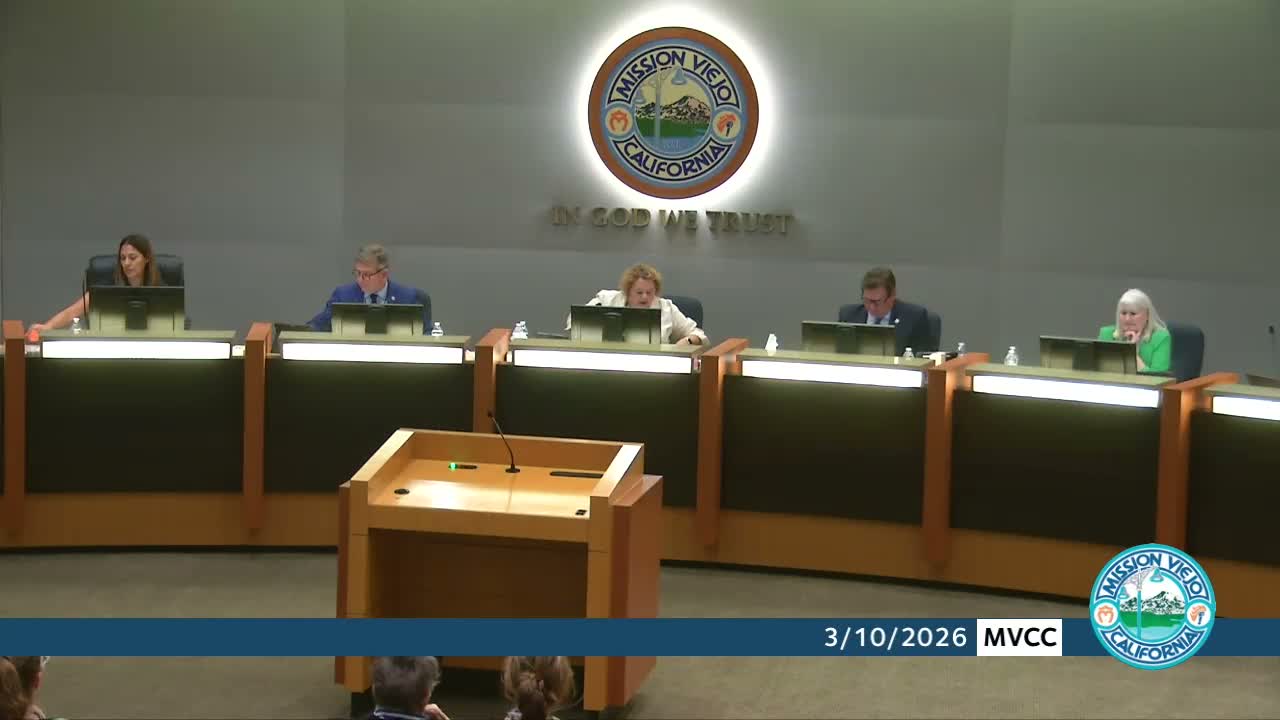
Mission Viejo council approves Vista Del Lago redevelopment amid intense resident opposition
Summary
After hours of public comment and detailed staff presentations about state housing law constraints, the Mission Viejo City Council voted 3–2 on March 10 to approve rezonings and permits allowing a 418-unit redevelopment at Vista Del Lago, including 53 deed-restricted affordable units; opponents cited height, parking, traffic and CEQA timing concerns.
The Mission Viejo City Council voted 3–2 on March 10 to approve a package of actions that will allow Equity Residential to redevelop a 3.87-acre portion of the Vista Del Lago apartment complex, clearing the way for a 6‑story, 418‑unit building and related zone and plan amendments.
The approved motion (introduce a zone‑change ordinance, adopt resolutions for the general plan amendment and planned development permit, and approve a tentative parcel map) implements part of the city’s sixth‑cycle housing element and relies on recent state housing statutes, including AB 130 and SB 131, that limit local discretion and create specific CEQA exemptions for certain housing element actions.
Why it mattered: Mission Viejo was assigned 2,217 units in the state RHNA and staff told the council the city must preserve sites and demonstrate compliance to avoid legal and financial penalties, including possible builders‑remedy development and loss of some state funding. Larry Longnecker, the city’s community development director, noted the Vista Del Lago site is listed in the city’s housing‑element inventory and the project is the first significant housing proposal the city has reviewed since 2020.
Project details: City staff and the applicant described the proposal as a redevelopment of a 33.64‑acre campus that would demolish 68 existing units on a 3.87‑acre parcel and construct a 6‑story wrap structure with a 7‑level wrapped parking garage. The project would increase the total units on the larger site to 958 and provide 15% of the net new units as affordable: 53 deed‑restricted units (26 very low‑income and 27 low‑income) maintained for at least 55 years, staff said. Planning staff identified requested deviations under density‑bonus law, including increased height, reduced open‑space metrics and bicycle‑parking waivers allowed under state law.
Traffic, parking and safety: City traffic engineer Mario Gutierrez told the council the study estimated about 1,400 net new daily vehicle trips associated with the project and roughly 127–128 net new trips in the AM and PM peak hours; staff said the intersections studied would remain within the city’s level‑of‑service guidelines and that, if post‑occupancy warrants are met, the city can require signal installation and other improvements. OCFA Deputy Fire Marshal Eric Evans said the agency had reviewed the conceptual plan and noted Orange County has ladder trucks with roughly 100‑foot reach and standpipe systems are standard for buildings of this height.
Strong public opposition and resident concerns: More than two dozen residents spoke against the plan during the council hearing, highlighting similar themes: building scale and view impacts from Pine Crest and other elevated neighborhoods; overflow parking onto neighborhood streets; questions about the traffic study and calls for an independent peer review; utility capacity (water, sewer) questions; wildlife and habitat concerns; and legal uncertainty about whether a CEQA exemption can apply given the applicant’s SB 330 (vesting) filing date. Carlos Pianelli and other residents urged the council to delay the vote to allow time for independent reviews; Pianelli told the council there were “16 deficiencies in that traffic report” submitted to them. Gerald Newkirk, president of the Pine Crest Community Association, cited parking and cut‑through traffic as primary neighborhood impacts.
Applicant’s position: Drew Sullins of Equity Residential said the company has owned Vista Del Lago for more than 30 years, emphasized commitments to resident relocation assistance and to providing the 53 income‑restricted units, and said the design would place the new building hundreds of feet behind existing landscaping to limit visual impacts. “We’re fully committed to supporting every resident through this transition,” Sullins said.
Council deliberation and vote: In debate, council members repeatedly returned to state housing laws that narrow local discretion, including the Housing Accountability Act and the density bonus framework, and warned of legal and financial risks if the city were found out of compliance. Several council members urged mitigation and ongoing monitoring; the approval includes conditions such as a post‑occupancy traffic analysis at the project entrances and a requirement that the developer post bond(s) to cover mitigation if warrants for signals or other improvements are met later. The motion passed 3–2; Council Member Vasquez said she voted no because she felt “the owners… did not make a concerted effort to involve the community.”
What’s next: The council introduced a zone‑change ordinance and adopted resolutions approving the general plan amendment and development permit. If the project continues through the entitlement process, it will still require construction‑level plan checks, permits and the implementation of the traffic‑analysis conditions and any mitigation required by later reviews. The city manager confirmed the council will monitor compliance and that developers must provide park‑in‑lieu fees and other required contributions before building permits are issued.
Documents and context: Staff repeatedly emphasized that state law (AB 130/SB 131 and recent amendments to density‑bonus and SB 330) changes how jurisdictions can apply objective standards and CEQA review to housing element sites. The council record and staff presentations note the city’s housing element is certified and that failure to maintain compliance could trigger builders‑remedy consequences for the city.
The council adjourned to its next regular meeting on March 24, 2026.