Get Full Government Meeting Transcripts, Videos, & Alerts Forever!
Get email alerts on the Public Safety topic
No spam. Unsubscribe anytime.
Orange Fire Department proposes ambulance‑operator expansion to restore staffing and boost revenue
Summary
Fire Department proposed converting remaining rescue ambulances to an ambulance‑operator (AO) staffed model to restore four‑person engine staffing on six of seven companies, increase net transport revenue, and create a dedicated capital reserve; council told staff to include the proposal in budget planning.
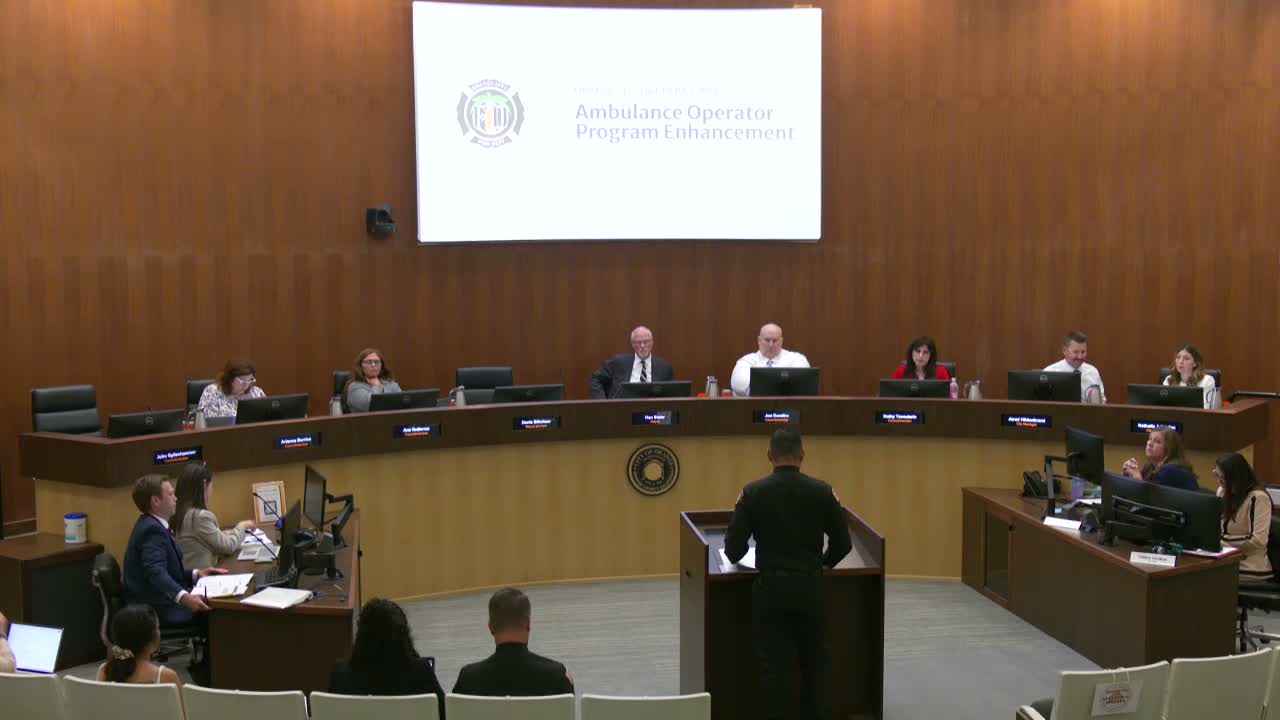
City of Orange fire officials presented a plan March 24 to expand the ambulance‑operator (AO) transport program as a revenue‑generating amendment to current operations.
Fire Department leaders said transitioning the remaining rescue ambulances to AO‑only staffing would allow sworn firefighters to return to engine companies and restore four‑person staffing on six of seven engines, a level the department said it has not fully achieved since 1995. The department described the proposal as aligning with industry norms used by several neighboring cities and as a way to increase frontline capacity while generating program revenue.
EMS Manager Brian Johnson and the Fire Chief explained the financial rationale: the current mixed model (sworn personnel on some transport units) creates higher vehicle and labor costs and volatile capital swings. Johnson said the AO model reduces labor costs, allows purchase of less expensive ambulances when replacements are needed, and supports setting aside 25% of net transport revenue for capital replacement. He told the council the AO model projection shows approximately $2.6 million more net revenue over five years compared with the current mixed model and estimated the program could produce $12 million net over five years under certain assumptions.
Startup costs for onboarding 18 additional limited‑term AO positions were estimated at about $1.0 million and would be covered from the existing transport fund (02/25) rather than the general fund. Staff said the fund could absorb the initial cost and that payback would occur within about two years as collections ramped up. The city manager and finance staff explained that including the expansion in the FY27 budget would shift about $600,000 of immediate impact to the general fund for staffing adjustments but that the program is projected to be self‑sustaining thereafter.
Council members expressed broad support for further work: several urged that staff include the AO expansion in budget materials and return a standalone staff report with implementation details, cost and staffing impacts, and requested the presentation include a slide directly comparing AO costs and general fund impacts. Council Member Demetrio and others praised the proposal’s service and fiscal benefits; the council directed staff to incorporate the proposal in forthcoming budget updates and to return with a formal action item.
If adopted as presented, the AO expansion would be included in the FY27 budget and phased to preserve engine staffing while using transport fund revenues to cover start‑up and capital replacement needs.