Get Full Government Meeting Transcripts, Videos, & Alerts Forever!
Get email alerts on the Budget topic
No spam. Unsubscribe anytime.
Orange council directs staff to study 1% sales tax as budget gap persists
Summary
Facing a structural budget shortfall, the City of Orange council received the midyear budget report, approved a $1.8 million appropriation for housing/building programs, and directed staff to study a potential 1% local transactions (sales) tax and other revenue measures to close ongoing deficits.
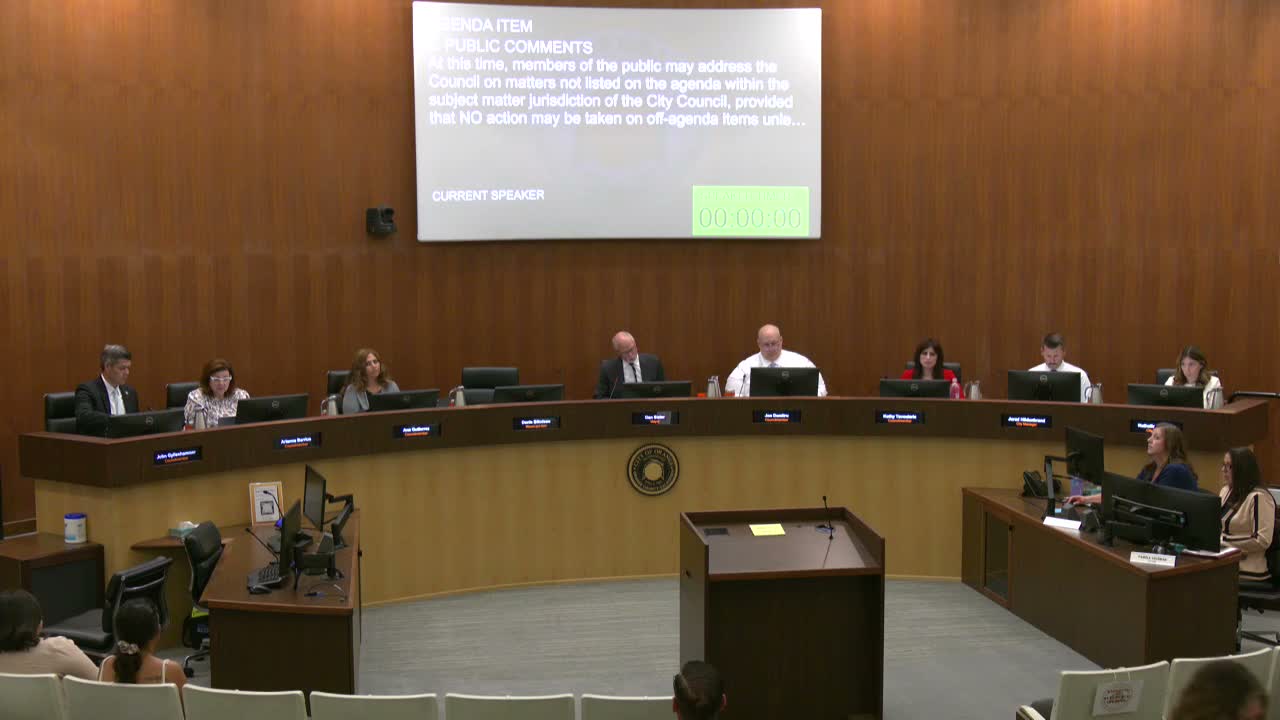
Mayor Dan Slater presided over a March 24 City Council meeting where council members received the fiscal year 2026 midyear report and directed staff to study a possible 1% local transactions (sales) tax as part of a broader package of revenue options.
The midyear presentation showed operating revenues for FY26 of about $153.8 million against estimated expenditures of about $158.9 million, producing an operating deficit the city estimated at roughly $5.1 million before transfers and a net deficit after transfers of about $2.1 million. Staff told the council the FY27 proposed budget projects roughly $153.7 million in operating revenues and $161.1 million in expenditures including debt service, yielding an estimated FY27 operating deficit of about $7.4 million before one‑time transfers.
The budget presentation — prepared with a 0‑based approach — detailed a set of balancing steps that include eliminating or freezing about 56 positions, leaving roughly 690 budgeted full‑time equivalents, using approximately $17 million in one‑time transfers from internal funds and proposing to hold a catastrophic reserve at 18% (about $25.8 million). Finance Director Trang Nguyen told the council staff had already trimmed the operating budget to the 'bare minimum' and that remaining reductions would be 'catastrophic' to services.
Council members pressed staff on what services would be affected by the staffing and capital reductions. Staff listed likely visible effects such as longer permit and plan‑check timelines, slower maintenance (parks, medians), potential closure of some low‑priority capital projects (roofs, gutters) and slower police response times if cuts continued. Council Member Demetrio said the proposal was "not a balanced budget — this is a deficit budget," arguing that one‑time transfers mask an ongoing shortfall.
On a procedural motion, the council voted to receive and file the FY26 midyear report and authorized the appropriation of $1,800,000 for building and home‑related programs (non‑general‑fund). The motion was moved by Council Member Demetrio, seconded by Council Member Gutierrez and approved with five ayes; Mayor Pro Tem Bilodeau was excused.
Staff presented modeling for several revenue options. Budget staff (Jack) showed a 1% local transactions tax could generate roughly $38 million annually in steady state, with partial receipts in the first year depending on election timing. Other options reviewed in isolation included an increase in transient occupancy tax (TOT), a utility user tax, a cannabis gross receipts tax modeled on Costa Mesa, and a private‑parking/parking tax applied to large private lots; staff emphasized that including transfers to internal service funds reduces net available revenue and that multiple measures may be needed in combination.
By consensus (no formal roll‑call vote), the council signaled direction for staff, in consultation with the city attorney, to conduct public‑opinion research and community outreach on a potential 1% local transactions/use tax, return with a draft ordinance and proposed ballot materials, and outline alternatives (TOT, utility tax, parking tax, vacancy tax and cannabis options). The city manager noted that materials for an autumn ballot would need to be packaged by July 14 to appear in the November voter packet.
The council’s next steps include additional budget study sessions in April, a preliminary budget in May and formal budget adoption in June. Staff emphasized that a sales tax (if approved) would not produce full year revenue until months after voter approval, and that near‑term fiscal discipline and contingency planning remain necessary.