Get Full Government Meeting Transcripts, Videos, & Alerts Forever!
Get email alerts on the Capital Improvement Program topic
No spam. Unsubscribe anytime.
Placentia committee presents 20-year capital forecast; staff seeks Measure U guidance to fund top projects
Summary
A volunteer Citizens Oversight Committee presented a long-range capital improvement forecast and staff recommended using up to 50% of Measure U revenues to fund nine priority projects. Council directed staff to begin with the top-ranked projects (the "red line") and return with a draft CIP in the May budget cycle.
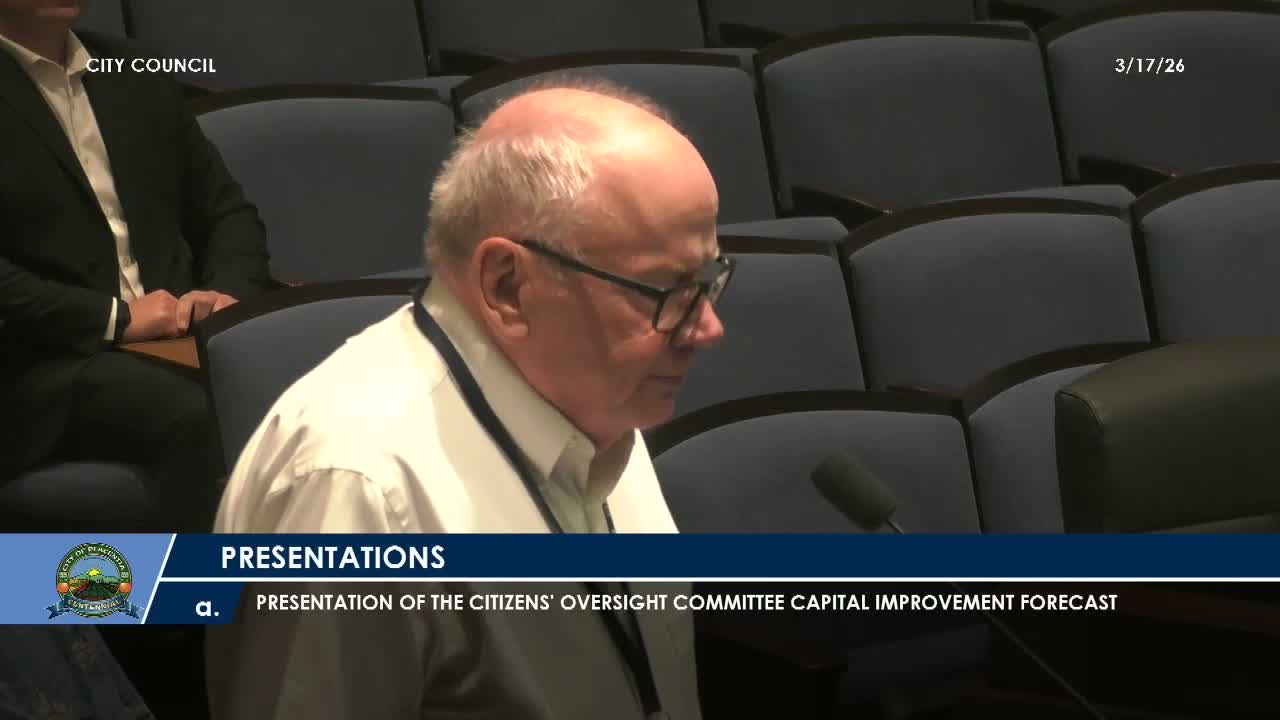
Citizens Oversight Committee Chair Robert McKennell presented a 10–20 year capital improvement forecast on March 17 that consolidates existing category forecasts and estimates citywide capital needs at roughly $12–13 million, with an annual sustainable streets budget of about $4.5–5.0 million.
"Our pavement index right now is 80," McKennell said, noting the score was 63 eight years earlier and that maintaining the current condition requires steady annual investment. McKennell described a methodology that annualizes capital needs so the city can plan rather than react, and urged separating public-safety vehicle forecasting from general fleet needs because of cost and lead-time differences.
City staff asked the council to choose between two Measure U funding scenarios for FY 2026–27: a conservative 40% allocation to infrastructure (funding the top seven ranked projects) or a recommended 50% allocation (funding nine projects, including the police department women's locker room and a city-yard admin building). "We received 24 project requests; 16 requested Measure U," deputy director Gabe Guerrero said during the presentation, explaining projects are prioritized on public health and safety, regulatory compliance, deferred maintenance, financial impact, strategic alignment, community impact and readiness.
Staff highlighted the top three priorities: arterial and residential street rehabilitation (Palm Drive repaving — a 1.1-mile arterial with an estimated $2.2 million construction cost — and a residential rehabilitation package estimated at $2.3 million), City Hall roof replacement (estimated $1.05 million), and the Kevin Way storm drain replacement (estimated $250,000).
Finance and oversight voices advised caution about permanently changing Measure U policy. "You don't change policy 4.60 because of a one-year thing," said oversight committee member Bob McKennell when asked about reserve policy; he explained council retains discretion to approve one-time uses of reserves. Mayor Pro Tem Jeremy Yamaguchi said he was "not comfortable going up to 50%" given external economic uncertainty and the need to protect reserves, while other council members urged balancing the promises made when Measure U passed with immediate infrastructure needs.
After extended discussion about reserves and risks, council members expressed support for directing staff to assemble the CIP starting with the projects above the red line (the highest-ranked projects under the 40% scenario) and to return with the detailed CIP as part of the proposed budget in May, with potential adoption in June. City staff told the council they would use the study-session guidance to finalize the proposed CIP and budget recommendations.
What happens next: staff will prepare a draft CIP and proposed budget attachments reflecting the council's direction to prioritize the top-ranked projects and will return in the May budget process for further council decisions and potential adoption in June.