Get Full Government Meeting Transcripts, Videos, & Alerts Forever!
Get email alerts on the Fire Department topic
No spam. Unsubscribe anytime.
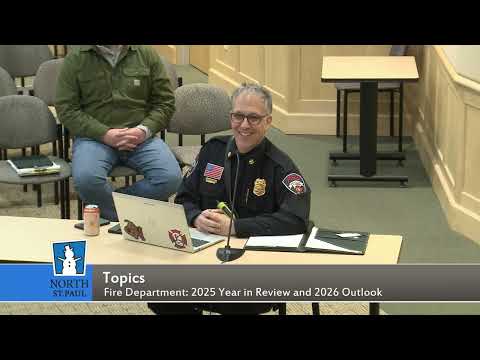
Fire Chief Mallinger reports 1,932 incidents in 2025 and outlines response, training and data upgrades
Summary
Fire Chief Jason Mallinger told the North St. Paul council workshop that the fire department handled 1,932 incidents in 2025 (about 5.2 calls per day), with EMS comprising the majority. He highlighted response times, mutual/auto‑aid patterns, training hours, an ISO rating of 3 and adoption of a new national reporting system and analytics tools for 2026.
Fire Chief Jason Mallinger reported that North St. Paul’s fire department responded to 1,932 incidents in 2025 — an average of 5.2 calls per day and roughly 158 calls per month — and said EMS calls made up the largest share of that volume. "We had 1,932 total incidents averaged 5.2 incidents per day," Mallinger said as he presented monthly and hourly call patterns to the council during the workshop.
Mallinger broke the 2025 caseload into categories: about 1,519 EMS calls, 326 classified as "other," and 87 categorized as fires. He emphasized that the bulk of activity is medical in nature and that call timing varies by hour and day; a heatmap he presented showed most calls occur between about 8 a.m. and 10 p.m. "A lot of what I have is related to our response and the numbers and what we've seen," Mallinger said.
Why it matters: council members pressed on capacity and overlap when multiple incidents occur simultaneously. Mallinger said the department experienced 202 overlapping incidents in 2025 — calls that arrived while crews were already on another call — creating recurring pressure on the city’s resources and reliance on regional partners.
Mallinger described how auto‑aid and mutual‑aid systems operate through Ramsey County dispatch. "Auto aid means 3 to 4 departments are dispatched at the same time to get resources there as quickly as possible," he said. He listed aid North St. Paul provided to or received from neighboring jurisdictions in 2025, including Maplewood, Oakdale, Roseville, Shoreview/North Oaks, White Bear Lake, Saint Paul and Lake Elmo. The department both sent and received mutual aid for fire and EMS responses throughout the year.
On performance metrics, Mallinger presented response-time data and compared them to common NFPA guidance. For fire incidents he reported a dispatch‑to‑en‑route mean of about 0:58 and a dispatch‑to‑on‑scene mean of 5:26; he reported dispatch‑to‑en‑route of roughly 0:12 and dispatch‑to‑on‑scene of about 2:38 for EMS calls, noting dispatch practices differ for EMS versus fire. "For a predominantly part‑time paid on‑call department this is really good response times," Mallinger said.
Mallinger also reviewed operational details: false‑alarm handling (including steps to remove recurrent problem alarms from service and seek repairs under the city ordinance or rental licensing agreements), six intentional false alarms recorded, and fire‑incident counts that included 38 structure fires and 24 outside/vegetation fires.
Training, inspections and accomplishments formed a major portion of the report. The department logged about 3,940 training hours in 2025 (roughly 106.5 hours per firefighter) covering live burns, forcible entry, firefighter‑down drills, incident command and EMS training. Mallinger said the Fire Relief Association joined the statewide volunteer firefighter (SVF) plan, six part‑time firefighters completed firefighter‑level and haz‑mat/EMR training, the department placed a new engine in service, conducted annual pump and SCBA testing with no failures, and maintained an Insurance Services Office (ISO) rating of 3.
Looking ahead, Mallinger said the department switched to the National Emergency Response Information System (NERIS) records platform on 2026‑01‑01 to improve national hazard data collection and analytics, and that the city partnered with Echo Data Analytics to extract live insights from ImageTrend record management. He listed near‑term priorities for 2026 including recruiting part‑time paid on‑call firefighters (34 currently), leadership development for lieutenants and captains, updating department policies, expanding interdepartmental training with police, continuing blood drives and CPR training in local schools, and ongoing partnerships with regional training facilities.
Council members thanked Mallinger for the detailed statistics and asked follow‑up questions about mutual aid and capacity. Mallinger offered to demonstrate the analytics tools for council members who wanted to see live data. The workshop then moved on to the electric department presentation.