Get Full Government Meeting Transcripts, Videos, & Alerts Forever!
Get email alerts on the Water Policy topic
No spam. Unsubscribe anytime.
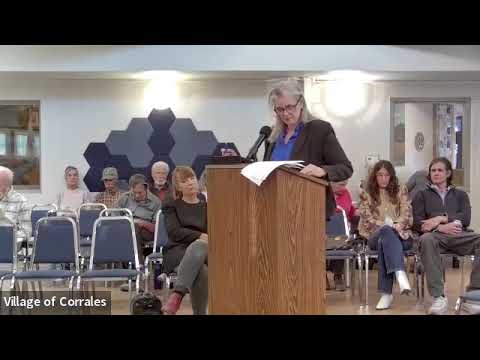
Rep. Kathleen Cates outlines state water investments, aquifer mapping and PFAS bill
Summary
State Representative Kathleen Cates told the Corrales Village Council that capital outlay funding secured projects in Corrales, highlighted major state investments for brackish‑water projects, $19 million for aquifer mapping, and said New Mexico enacted PFAS protections; she also noted authority for municipal stormwater fees.
State Representative Kathleen Cates briefed the Corrales Village Council on this year’s legislative results, emphasizing water infrastructure, PFAS regulation and several capital outlay grants that she said benefit Corrales.
Cates said capital‑outlay requests for Corrales — including fire apparatus, rescue ambulance and fire‑station construction — were funded, and she credited additional governor’s funding for some projects. She also described a Strategic Water Supply Act she said now funds brackish‑water projects and includes $19 million for statewide aquifer mapping and another $4 million for research. “We cannot plan water unless we can measure water,” Cates said, arguing the mapping is a necessary first step.
Cates said New Mexico Tech’s January 2024 research indicates the state may face 20–25% less water in 50 years, which she used to underscore the need for investments in reuse and brackish‑water projects. She highlighted incentives to reuse nonpotable sources and called out large consumptive users such as oil and gas.
On PFAS, Cates said the Legislature passed a bill (she referred to it as the PFAS bill) intended to strengthen protections and funding; she said she and others signed the measure and that the governor had signed several water bills. She also noted a statutory change allowing municipalities to charge a stormwater service fee, a new authority Cates said could help Corrales manage runoff and aquifer recharge.
Councilors asked technical follow‑ups: whether New Mexico Tech’s water projection incorporated unmapped/brackish sources (Cates said the report used scientific models and that mapping is incomplete); whether federal funding was designated for the Clovis/Cannon Air Force Base PFAS response (Cates said she was not aware of designated federal funding beyond military infrastructure); and the status of House Bill 28 (Cates said it was defeated in committee but could be reintroduced in a future session with NMFA engagement).
Next steps: Councilors and staff said they will use the update to inform local water planning and to follow up on grant timelines and state coordination.