Committee passes bill barring local bans on retail pet stores after heated debate
Loading...
Summary
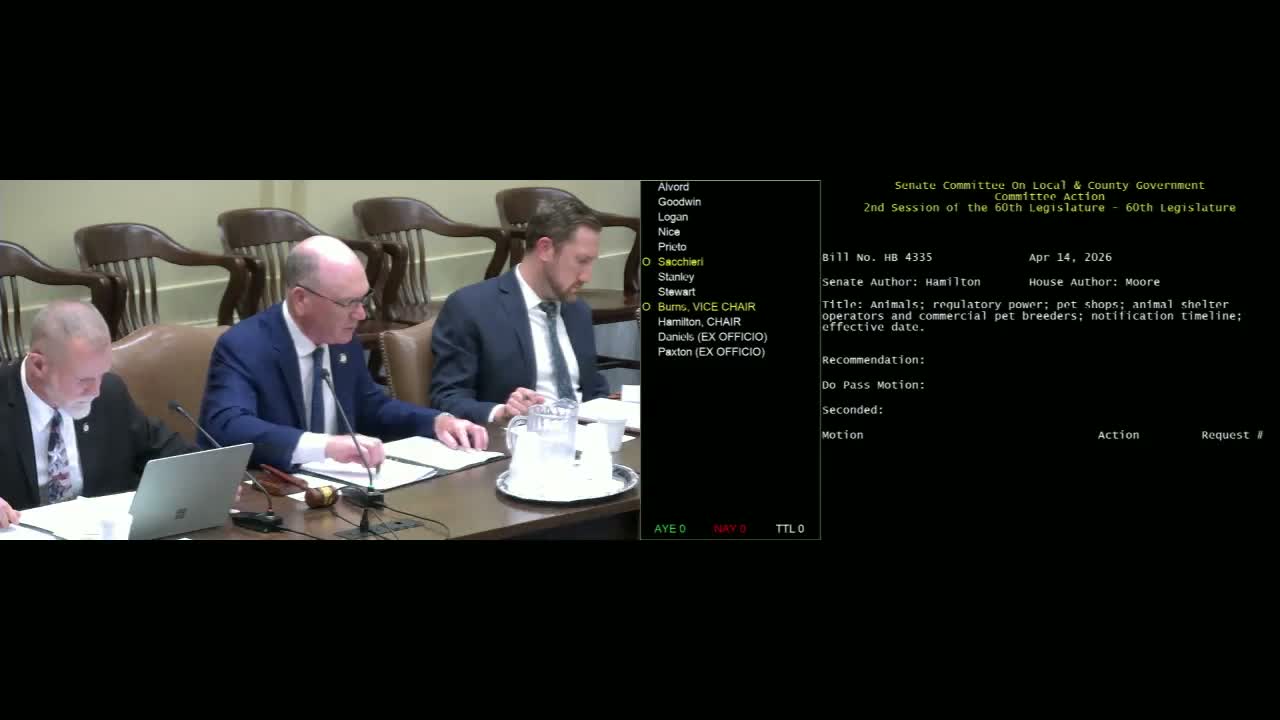
House Bill 4335, which prevents municipalities and counties from banning retail pet stores selling dogs and cats (with a grandfather clause for ordinances enacted before 2026‑01‑01), passed the committee 6–3 after extended questioning about local control, animal welfare, and ties to large retailers.
House Bill 4335, offered in the Senate by Senator Hamilton, would prevent municipalities and counties from banning retail pet stores that sell dogs and cats, while exempting ordinances enacted before Jan. 1, 2026. The bill drew extended questioning and debate over whether the measure preempts local control and whether it would favor large retail chains.
Senator Stanley asked whether any local ordinances are grandfathered; the sponsor confirmed a grandfather clause applies to county or municipal ordinances enacted prior to 01/01/2026. Senator Goodwin and others repeatedly raised concerns about local governance being limited by the bill’s language and whether specific retailers were influencing the proposal. Goodwin pressed the sponsor on reports of animal‑care problems and high retail prices for puppies; when a senator suggested puppies sometimes sell for $3,000 to $7,000, the sponsor replied that pricing is not the subject of the bill.
Senator Nystree (debating against the bill) cited animal welfare concerns and said Oklahoma City euthanized about 16 animals that day, projecting that could scale to roughly 80–100 animals a week; she said those shelter pressures argue for preserving local control to regulate outlets that affect shelter populations. The sponsor, Hamilton, defended the bill on free‑enterprise grounds and cited statewide economic figures he said were tied to pet industries — including an employment estimate of roughly 20,000 jobs in pet‑related goods and services and an economic benefit he placed near $1,000,000,000. After debate, Hamilton asked for the committee’s yes vote; the roll call produced six ayes and three nays and the chair declared the bill passed.
The committee record shows no amendments adopted in committee. Several senators asked for more information during questions (including whether specific municipalities had been exempted in earlier drafts and whether the bill applies to private institutions for the prior item); the sponsor said he would follow up on outstanding clarifications outside the hearing.
The committee advanced the bill by a 6–3 vote.