Senate finance panel backs fee on some international transfers to fund TennCare buybacks and workforce programs
Loading...
Summary
On April 14, 2026, the Tennessee Senate Finance, Ways and Means Committee adopted a finance amendment to Senate Bill 21 66 that would impose a $10 fee on transfers up to $500 and 2% on amounts over $500 for certain wire transmitters originating in Tennessee, with proceeds earmarked for TennCare buybacks, childcare and workforce housing programs.
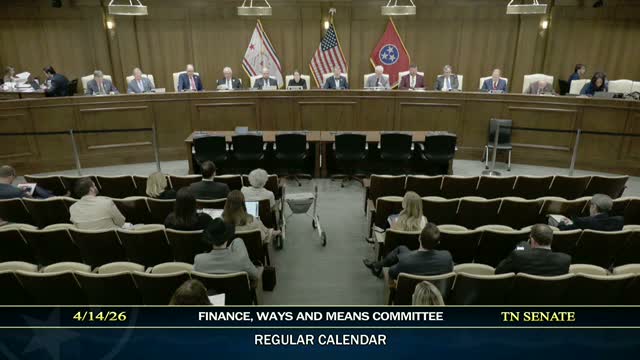
The Senate Finance, Ways and Means Committee voted on April 14, 2026, to recommend a finance amendment to Senate Bill 21 66 that would create a user fee on certain money transfers sent from Tennessee to foreign countries.
The chair explained the amendment would apply only to licensed wire transmitters — not banks or traditional financial institutions — and would charge $10 on transactions up to $500 and 2% on amounts above $500. The chair said the proposal could generate “up to over $55,000,000 per year.” The amendment passed in committee and the bill as amended was recommended for passage to the calendar.
Why it matters: Sponsors said the amendment is designed to capture revenue from nonbank transfer services and to dedicate proceeds to specific state priorities. The chair outlined earmarks in the amendment: roughly 20% (about $5.4 million) to the general fund; about 51.5% (roughly $14.1 million) toward TennCare buybacks as part of a broader $137 million buyback obligation; $10 million for a Tennessee workforce housing initiative; approximately $1.3 million for a teacher internship fund; and $5 million for a childcare program to support workforce development.
Committee discussion focused on who would be covered, whether ordinary bank-to-bank transactions would be exempt, and the practical administration and collection challenges. Senator Hensley asked whether the $10 fee applies to very small transfers; the chair clarified the $10 applies to transfers up to $500, and 2% applies only to amounts over $500. Senator Lamar raised concerns that some ordinary Americans using nonbank services while traveling abroad could be taxed depending on the transaction method. The chair responded that transactions initiated through Tennessee banking institutions generally would not be taxed but that certain peer‑to‑peer and nonbank pathways could fall under the fee.
Members also questioned whether the carve-outs and enforcement would be practical and whether the projected revenue in the fiscal estimate accounted for collection challenges. The committee record shows several members asked for clarification on administration and legal authority; the chair said the key statutory hook is that the transactions are initiated in Tennessee.
The committee adopted the finance amendment and recommended the bill as amended for placement on the calendar. The committee did not vote on final passage of the bill in the full Senate during this session; the next procedural step is placement on the chamber calendar.