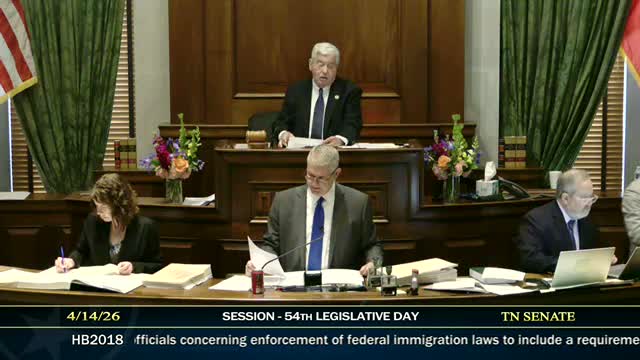
Senate adopts amendment to require sheriffs with 287(g) agreements to honor ICE detainers; fiscal concerns raised
Loading...
Summary
Senators adopted a finance amendment to House Bill 2018 (conforming amendment on third reading) requiring sheriff's departments with 287(g) memoranda to accept and honor federal ICE detainers; debate centered on whether the amendment shifts significant costs to counties and how the measure interacts with other budget legislation.
The Senate adopted a finance committee amendment to House Bill 2018 that narrows application to sheriff's departments that have a memorandum of understanding under the federal 287(g) program and requires those departments to accept and honor ICE detainers when issued. The amendment and the bill were then passed on third reading.
Sponsor Senator Taylor said the amendment reduces the original judiciary committee language (which applied to all sheriffs) to only those counties that participate in 287(g), and reiterated that prior special‑session actions and budget allocations had contemplated county participation. He described 287(g) as a federal‑local program allowing local authorities to notify ICE when an individual in custody may be subject to immigration enforcement and, if ICE issues a detainer, to hold the person up to 48 hours to facilitate transfer.
Senator Yarbrough raised a fiscal concern: he noted a fiscal note on an earlier version estimated roughly $5.4 million annually and warned that pairing this amendment with separate budget language could effectively make 287(g) mandatory and shift recurring costs to county governments. He said the amendment appeared to paper over the cost and limit local governments' ability to manage budgets and liability. Senator Taylor and other supporters said the current amendment applies only to counties already participating in 287(g) and that earlier budget funding had anticipated costs.
Senator Campbell asked how liability for potential legal challenges would be allocated; the sponsor said such disputes would be adjudicated in federal court and portrayed the measure as a notification/transfer process rather than new criminalization. After debate, the amendment was adopted and the bill passed; the transcript records the bill as passed with a declared constitutional majority.
The transcript shows robust on‑floor debate about fiscal and legal implications but does not record detailed implementation steps or subsequent administrative guidance.