Lifetime Citizen Portal Access — AI Briefings, Alerts & Unlimited Follows
Informational hearing on bill that would let counties steer large solar projects focuses on farmland protection and property rights
Loading...
Summary
At an informational hearing on SF 4479, farmers and clean-energy interests clashed over whether allowing county boards to designate prime farmland as unsuitable for large power facilities protects agriculture or improperly restricts landowner choice. Testimony and committee questions highlighted uncertain decommissioning science, examples of large projects, and local-control trade-offs.
An informational hearing on April 13 before the Senate Committee on Agriculture, Veterans, Broadband and Rural Development examined Senate File 4479, a proposal to give counties an optional tool to identify certain agricultural lands as unsuitable for large electric power facilities.
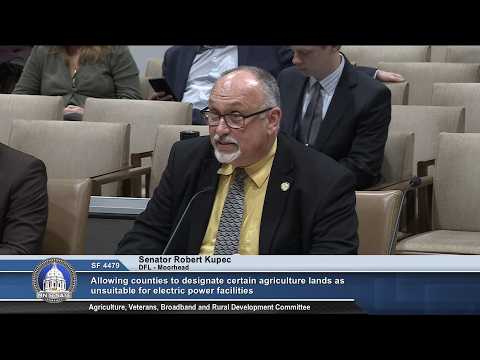
Sponsor Senator Kupak framed SF 4479 as "an optional tool to help protect Minnesota's best farmland" and said the measure is not an anti-solar bill but a mechanism for counties to weigh soil productivity and long-term agricultural value when large-scale projects are proposed.
Dana Allen Tully, a board member of the Minnesota Corn Growers Association, testified the state has seen significant farmland loss and that utility-scale solar projects "take a minimum of 400 acres out of production," citing local projects north and west of her farm of about 1,800 and 1,500 acres respectively. She warned that offers to lease land at four to five times market rents make it hard for new or beginning farmers to access ground in the long term and said counties should have at least some input into siting decisions.
Renewable-energy developers and trade groups testified in opposition. Alex Cutchy of Geronimo Power told the committee, "That's not farmland protection. That's farmland control," arguing the bill would allow counties to override landowner choice and impair options that provide income stability for farming families. Madeline Smarillo of the American Clean Power Association cautioned that removing landowner choice could chill investment; she provided association figures that utility-scale projects contribute tens of millions annually statewide in land-lease payments and local tax revenue and said studies the ACP reviewed did not find health risks from panel breakage.
Committee members pressed both sides on the empirical evidence. Senator Holmstrom and others asked whether decommissioned sites show soil contamination or other long-term damage; witnesses said the concern is largely hypothetical in Minnesota because few large projects have been decommissioned here, though they recommended studying remediation and decommissioning plans. Members also explored co-use models — grazing sheep or cattle under arrays — and asked the presenters to share studies and fact sheets.
Chair Putnam emphasized the hearing was informational; no action was taken and the bill was held over for possible inclusion in the committee's amendment vehicle. Committee members signaled they will continue the conversation, seek additional research and examples of site restoration, and consider alternatives such as using CREP or other lower-quality land for siting.
Exchange highlights (selected): - Dana Allen Tully (Minnesota Corn Growers Association): "Minnesota's farmland is one of our state's most valuable resources." - Alex Cutchy (Geronimo Power): "That's not farmland protection. That's farmland control." - Madeline Smarillo (American Clean Power Association): the association's review "indicated that [leaching/toxic chemical] is not a concern," and that the industry provides substantial annual lease and tax revenues to farmers and local governments.
Because the hearing was informational, the committee did not vote on SF 4479 on April 13; the measure will remain under discussion and may be amended or folded into the committee's pending vehicle for later consideration.