University of Michigan students present regional urban deer management plan; local official reports sharpshooter operations and venison donations
Loading...
Summary
A University of Michigan capstone team presented a four-phase regional urban deer management plan to an Ann Arbor municipal commission, recommending resident surveys, targeted monitoring, and phased implementation. An agency official reported recent coordinated sharpshooter operations that yielded more than 2,000 pounds of venison donated to local food banks; no formal vote was taken.
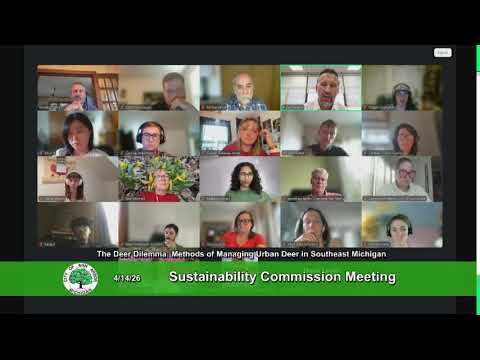
University of Michigan students on a capstone team presented a regional urban deer management plan to an Ann Arbor municipal commission on the topic of coordinating deer-control efforts across Southeast Michigan.
The students outlined a four-phase approach — baseline data collection, plan initiation with municipal adoption, implementation of control methods, and long-term monitoring — and emphasized using standardized templates so neighboring municipalities can adopt similar procedures without reinventing policies.
The plan’s adviser, Mike Cost, introduced the project and identified the client as the Southeast Michigan Urban Deer Coalition, chaired by Brian Farmer of Farmington Hills. Student presenters Chelsea Young, Zach Kavanaugh, George Ackerman, Tristan Compton and Lauren Jones described the scientific and social rationale for regional management, methods for counting deer, and both lethal and nonlethal management tools.
Chelsea Young summarized ecological and social impacts, citing a student-compiled figure of about 35 deer per square mile for Michigan (reported for 2024) and noting that Oakland County recorded 2,125 deer-vehicle collisions in 2023. She said resident surveys show top concerns are vehicle collisions, tick-borne disease and landscaping damage.
Zach Kavanaugh and George Ackerman described the Southeast Michigan Urban Deer Coalition (formed in 2021 with roughly 25–30 member communities and organizations), and the students said they built the plan around three pillars — ecology, social context and implementation — with templates for local resolutions and materials for public education.
Tristan Compton reviewed implementation options and costs. He said sharpshooter operations and organized hunts remain the most effective lethal strategies when coordinated with federal, state and local partners, noting an indicative cost of about $5,000 per sharpshooter evening; he also listed nonlethal tools such as fencing, repellents and landscape design as useful supplements.
Lauren Jones closed by emphasizing monitoring and public engagement: the students recommended continuing social and ecological surveys for at least five years to measure program effects and suggested demonstration projects (deer exclosures) and citizen-science photo monitoring to inform residents and collect data.
During questions, an agency official who spoke at the meeting provided a status update on regional operations. The official said a winter program coordinated among Southfield, Farmington and Farmington Hills used USDA-contracted sharpshooters and that harvested venison — more than 2,000 pounds, by the official’s account — was distributed to local food banks (Farmington Hills and Farmington deliver to a local food bank identified as Cares). The official said the Farmington Hills program was approved to continue annually and that Livonia has signed a USDA agreement to conduct sharpshooting next year. The official described a hybrid approach for future seasons: multiple archery days supplemented by sharpshooter efforts to meet municipal harvest goals.
No ordinance, resolution or formal motion was introduced or voted on at the meeting; the presentation concluded and the student team offered to remain for additional questions. The commission did not take formal action during this agenda item.
Key takeaways: the students provided a clear, phased template intended for municipal adoption; coalition members and several neighboring cities have already initiated or approved operations; and the approach couples data collection and sustained public engagement with targeted population-control methods.
Next steps noted at the meeting: commissioners and staff can refer the students’ templates to their councils or study sessions for consideration, and coalition partners expect to continue annual operations and expand participation among nearby municipalities.