Get Full Government Meeting Transcripts, Videos, & Alerts Forever!
Get email alerts on the Public Health topic
No spam. Unsubscribe anytime.
Board directs staff to modernize temporary food, community‑event rules to ease barriers for small organizers
Summary
The board unanimously directed staff to review and recommend updates to county policies governing community events and temporary food facilities, aiming to reduce paperwork, clarify nonprofit eligibility and enable cross‑county mobile vendors while keeping public‑health protections.
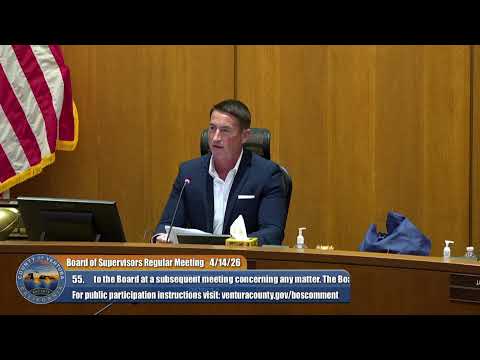
The Ventura County Board of Supervisors on April 14 voted unanimously to direct county staff to study and return recommendations to modernize rules for community events, temporary food facilities, and event organizer eligibility.
Supervisor Parvin said the county’s current framework — adopted in 2013 — is creating unnecessary barriers for small businesses and community groups, particularly by requiring formal nonprofit documentation such as local proclamations or out‑of‑state 501(c)(3) paperwork. Parvin asked staff to evaluate alternatives, including streamlined verification, online permitting, modular training, and limited temporary participation for mobile food vendors permitted in neighboring counties provided they initiate permitting in Ventura County.
Parvin said the goal is to reduce administrative burdens while maintaining public‑health safeguards: “We want to keep everybody safe but also remove unnecessary barriers for event organizers,” she said. Board members thanked environmental health and code compliance staff for engaging on the issue and urged practical, operational recommendations.
The motion, moved by Supervisor Parvin and seconded by Supervisor Long, passed unanimously. Staff were asked to return with findings and recommended policy language and to consider how newly procured permitting software might streamline processes.