Get Full Government Meeting Transcripts, Videos, & Alerts Forever!
Get email alerts on the Appellate Hearing Hearsay topic
No spam. Unsubscribe anytime.
Appellate counsel urges reversal, says trial judge relied on hearsay in Schweitzer revocation
Summary
At oral argument, Colin Patrick of the Washington Appellate Project told the court the trial judge relied on hearsay without a required good-cause finding when revoking Carl Schweitzer's supervision; the State said the claim was waived if not raised below.
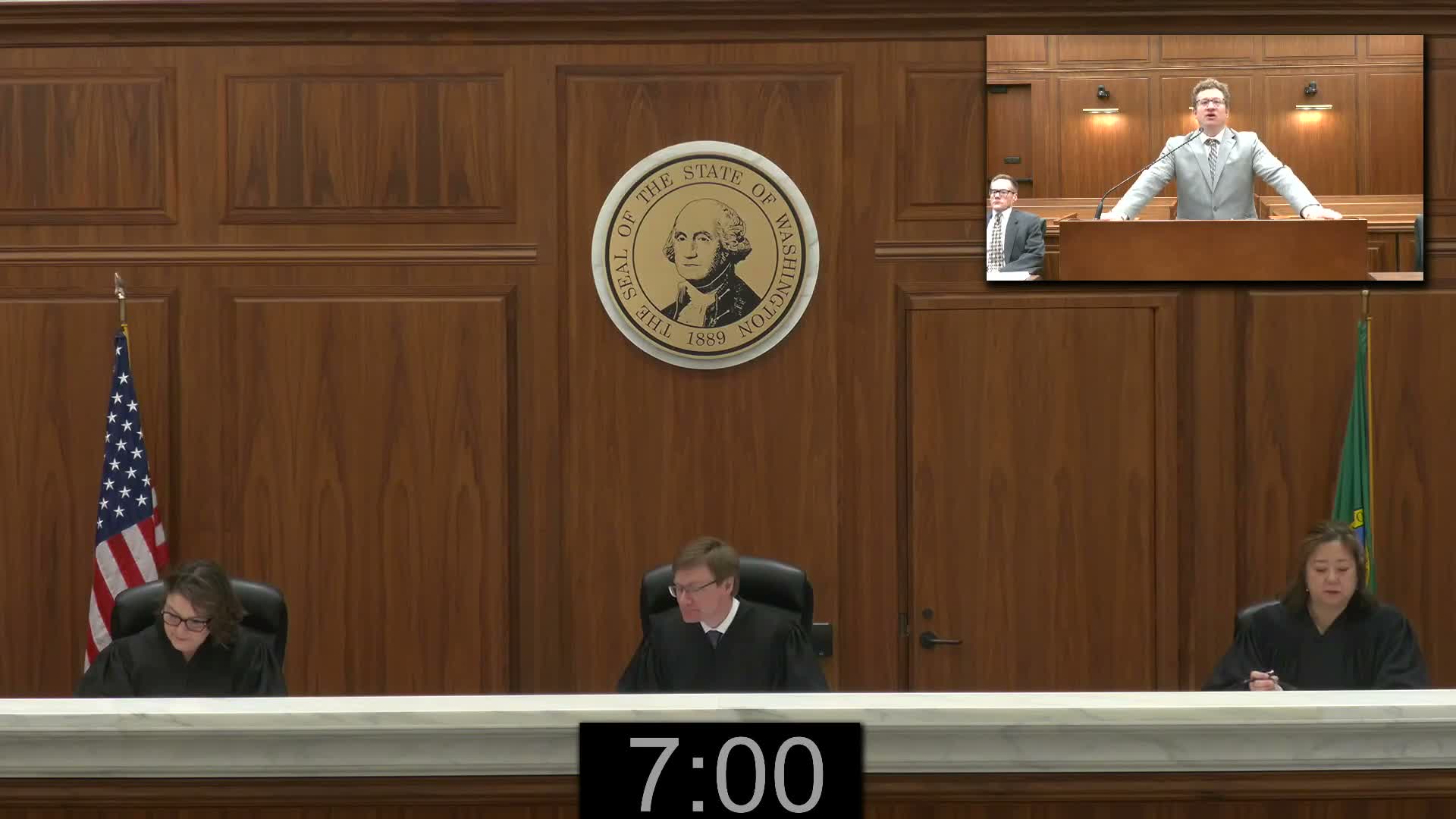
Colin Patrick of the Washington Appellate Project told the court at oral argument that the revocation order in State of Washington v. Carl Schweitzer should be reversed because the trial court relied on hearsay without making the Morrissey good-cause finding required to forgo live testimony. "Due process precludes a court from relying on hearsay without first making a good cause finding to forego live testimony," Patrick said.
The issue, Patrick said, included descriptions drawn from internet sources about films the defendant allegedly watched and other evidence in the record. He argued the trial court’s written and oral rulings — which the appellant says say only that the judge relied on "all supporting documentation" — do not identify which evidence the court actually relied on, and that ambiguity makes harmless-error review impossible under Dahl and related authority.
Matthew Pittman, a deputy prosecuting attorney for Snohomish County, told the court the defense’s failure to raise a specific confrontation-clause objection below means the claim is forfeited on appeal. "We just say it's waived," Pittman said, citing State v. Nelson and Burns in arguing that 2.5(a)(3) review for manifest constitutional error does not apply where the confrontation objection was not raised at the hearing.
The justices pressed both sides on finer points of preservation. One justice observed that revocation hearings commonly have the community corrections officer present and available for examination, a fact the bench said bears on whether a confrontation objection should have been made at the hearing. Counsel disputed whether the objection below was sufficiently specific to trigger a Morrissey finding, with Patrick arguing the phrasing that counsel used — telling the court it could not "rely" on certain hearsay to find a violation — was functionally equivalent to the constitutional objection required to demand live testimony.
The State countered that invited-error and waiver doctrines apply where defense conduct below was ambiguous, and urged the court to presume the trial court did not rely on inadmissible material unless the record shows otherwise. Pittman also argued that, even if 2.5(a)(3) is considered, the appellant must show manifest constitutional error and identifiable prejudice.
The bench and counsel also focused on a specific record item (identified in the argument as CP 89), described in the transcript as a film clip "halfway through season 2 episode 5" with roughly 20 minutes remaining and further redacted explicit material; the bench asked whether the judge relied on that clip rather than internet summaries. Patrick emphasized that the trial court’s orders fail to say what evidence was decisive and urged reversal on that basis.
The argument closed without a decision from the court. "That will conclude the argument calendar today," the presiding justice said.
The dispute centers on preservation and the proper standard of appellate review: whether the defense preserved a constitutional confrontation claim that would shift the burden to the State to show any error was harmless, or whether the claim is forfeited and subject to the higher bar of 2.5(a)(3) review. The court will resolve those questions in its forthcoming opinion.