Get Full Government Meeting Transcripts, Videos, & Alerts Forever!
Get email alerts on the Public Safety topic
No spam. Unsubscribe anytime.
Commissioners face growing pressure over failed sirens, radios and dispatch funding; officials push to restore sheriff payroll and complete tower work
Summary
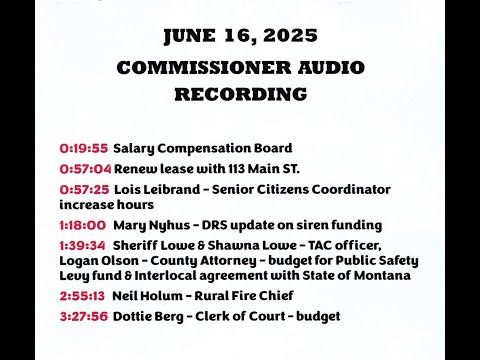
Daniels County commissioners heard urgent pleas from emergency-services staff and volunteers about repeated radio and paging failures, a reduced EMPG grant for DES, and a stretched 9-1-1/public-safety budget. Commissioners agreed to pursue state contract clarifications, a Nemont Internet connection and steps to move an undersheriff’s pay back into the sheriff’s regular budget to preserve mill-levy funds for equipment.
Commissioners spent the bulk of their June 16 meeting grappling with long-standing emergency-communications problems — a delayed tower and trunking project, a radio system that mispaged responders during a recent house fire, and the fallout from reallocating personnel costs among the 9-1-1 fund, the sheriff’s general fund and a temporary public-safety mill levy.
Mary (S9), the county’s emergency-services coordinator, told the commission that federal Emergency Management Performance Grant (EMPG) support for small counties has been reduced; where small counties had previously been eligible up to $25,000, she said that allotments appear to be as low as $10,000. “We got cut, so…you’re gonna have to make a decision…how important is the DES coordinator and how much you want to fund that position,” Mary said, urging commissioners to weigh the coordinator’s local role in grant-writing and hazard-mitigation work.
Multiple speakers, including dispatch staff and volunteer responders, described cases in which pages or radio messages did not reach crews during recent incidents. One staff member (S2) recounted a recent house fire where the initial page apparently did not reach crews and later said tests showed intermittent paging problems. Those operational failures prompted strong language: dispatch leadership and volunteers warned they could stop volunteering if equipment and paging reliability are not fixed.
Budget and funding debate: Commissioners, the sheriff’s office and finance staff reviewed how prior decisions — city contributions to dispatch, use of the 9-1-1 fund, and a public-safety mill levy — have shifted payroll and equipment responsibilities. Several commissioners supported moving an undersheriff’s pay out of the public-safety mill-levy account back into the sheriff’s general fund next fiscal year to preserve the mill levy for equipment upgrades. Staff highlighted that the dispatch payroll budget is underfunded (payroll needs exceeded the existing dispatch budget) and noted that short-term uses of the mill levy for payroll will reduce the money available for capital upgrades when the levy sunsets.
Procedural steps taken: Commissioners approved two near-term items intended to relieve communications problems: awarding a Nemont high-speed Internet contract to add a direct link from the sheriff’s office to the hill-top site (a vote to accept the Nemont bid was passed), and instructing staff to press the state and contractors to finalize outstanding contract language for the tower and trunking project. Commissioners asked staff to prepare an itemized list of priorities for the public-safety mill levy and to pursue contract and FAA clearances with daily follow-up.
Why it matters: Reliable paging, radio trunking and a funded plan for staffing and equipment are essential to emergency response. Commissioners described this as a liability and safety concern for the county; some volunteers said persistent failures have brought them to the brink of resignation.
What’s next: Staff were asked to return with a clear budget plan that moves the undersheriff’s pay back to the sheriff’s budget for the next fiscal year where possible, to provide a prioritized equipment wishlist for the mill levy, and to report on contractor/FAA progress on the tower and microwave/backhaul connections.