Henrico Board adopts $2 billion fiscal 2027 budget after extended debate over school staffing
Loading...
Summary
The Henrico County Board of Supervisors adopted the fiscal 2027 operating and capital budgets — roughly $2 billion and $343.6 million respectively — after a lengthy debate over school funding, state shortfalls tied to the Local Composite Index and requests for additional English-language-learner positions.
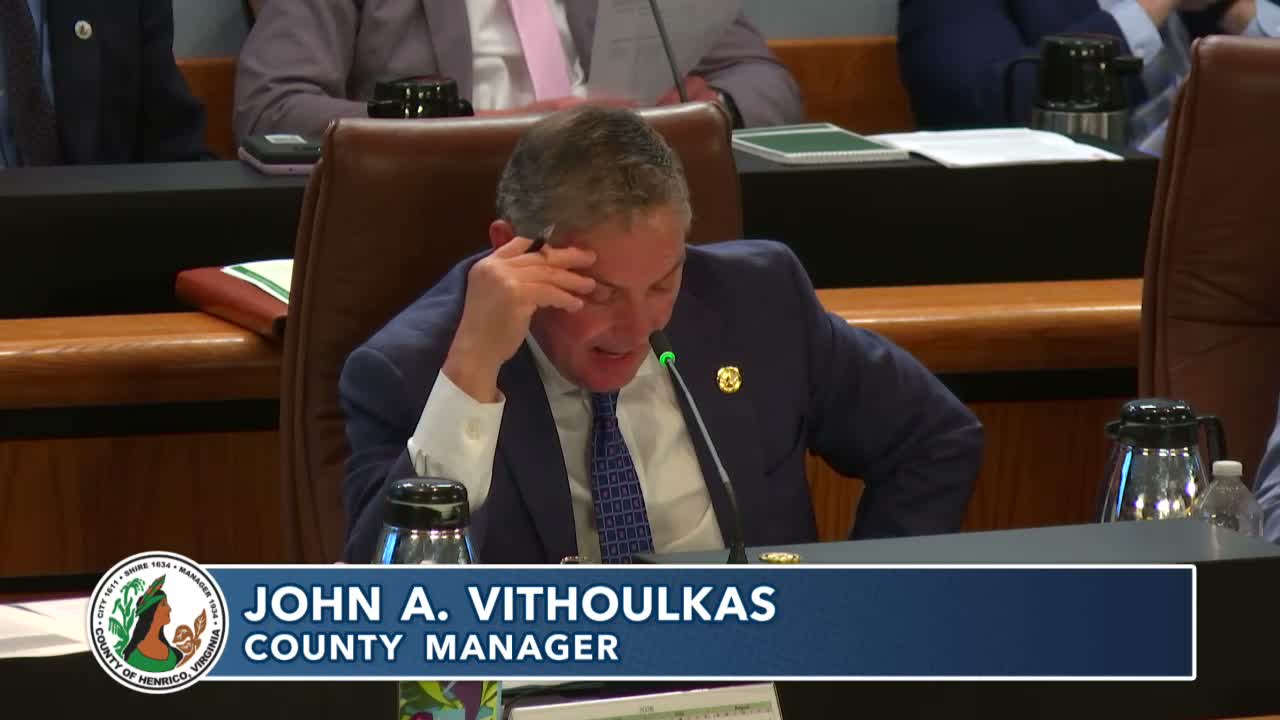
The Henrico County Board of Supervisors voted April 14 to adopt the county's fiscal 2027 operating and capital budgets after several hours of discussion about education funding and priorities. Justin Crawford, the county's budget director, said the operating plan totals nearly $2,000,000,000 with a capital budget of $343,600,000.
The vote followed extended exchanges about a state funding shortfall driven by the Local Composite Index (LCI). Crawford told the board the state-estimated required local effort for education is about $274,000,000 and that the county used local revenues to backfill an LCI-driven shortfall of roughly $12.5 million. "The operating budget totals nearly $2,000,000,000," Crawford said during his overview.
Board members pressed staff and one another on whether the school division's requests — including new English-language-learner (ELL) teacher positions raised in public comment — could be accommodated within the proposed school budget. Supervisor Justin Smith (speaking as himself) framed the question in budget-percentage terms and urged the school division to prioritize within its $900 million-plus operating budget. "Those positions, if we funded them all, cost about $6,000,000," Smith said. "That's roughly two-thirds of 1 percent of a $900,000,000 operating budget — it's a prioritization decision." He and other supervisors reiterated that the board cannot set school staffing line by line under state law but can approve overall funding levels and later act on budget amendments.
Several supervisors described the budget process and past practice of in-year amendments, and emphasized that local revenue was used to cover the LCI decline. "We took local revenues to backfill that shortfall," Crawford said, noting the county's decision to keep school funding whole despite the state change. Vice Chair Misty Rountree and others said the board has consistently prioritized schools and highlighted past measures — including meals-tax allocations — that have supported school construction and programming.
Public commenters and school advocates urged full funding for ELL and special-education positions. Frank Callan, an educator, told the board he supported the school board’s request for 50 ELL teachers and additional special-education positions and urged supervisors to consider the long-term consequences of understaffing those programs.
After the discussion and the opportunity for staff to answer questions, the board moved and adopted the fiscal 2027 operating and capital budgets by voice vote. Chair Roscoe D. Cooper called for the vote and noted the motion carried.
The county set the allocation of car tax relief at 42 percent for calendar year 2026; Crawford said that allocation is unchanged. County staff said budget amendments remain possible during the fiscal year and that additional state revenues, if received, could be addressed through follow-up actions or amendments.
What happens next: With the board's adoption, staff will finalize appropriation schedules and begin implementation for fiscal 2027; supervisors noted they will continue to monitor school staffing priorities and consider amendments if additional revenues or needs arise.