Get Full Government Meeting Transcripts, Videos, & Alerts Forever!
Get email alerts on the Homelessness topic
No spam. Unsubscribe anytime.
Seattle council approves emergency shelter funding, expands leasing authority to speed tiny-home and encampment sites
Summary
The council approved two related bills on April 14 to expand shelter capacity: one grants the Finance and Administrative Services director authority to sign leases for transitional encampment sites; the other authorizes funding for rapid shelter expansion, both passing by recorded votes of 7–0.
Seattle City Council voted April 14 to approve two related measures intended to speed the siting and funding of shelter options for people experiencing homelessness.
Council bill CB121184 grants the director of Finance and Administrative Services expanded authority to execute leases for land used for transitional encampments; council members described the measure as a practical step to speed site acquisition. The council approved that bill on a 7–0 recorded vote.
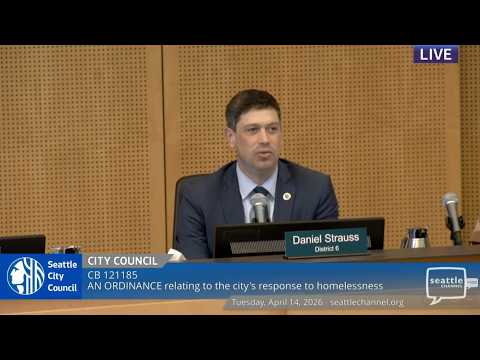
Council bill CB121185, a budget and ordinance package tied to the city’s response to homelessness, also passed 7–0. Sponsors said the funding would permit faster leasing and development of tiny home villages, increase per-site client caps at interim-use sites, and allocate $4.9 million toward immediate shelter expansion in the near term.
Public comment before the votes was overwhelmingly in favor of rapid shelter expansion. Speakers representing service providers, former shelter residents and shelter staff urged passage. Martha Kidana of the Low Income Housing Institute told the council the $4.9 million allocation and expanded leasing authority would “complete the funding package to bring these shelter beds from a concept to a reality.”
Multiple service providers, including therapeutic and recovery programs, described the importance of on-site behavioral health, case management and medically assisted treatment in helping residents stabilize. Licensed clinical social worker Caitlin Schubach said her team’s presence in tiny home villages provides immediate access to master’s-level clinicians without long intake delays.
Council members stressed that the measures are a first step and that additional work remains to ensure service levels match residents’ needs. Council member Strauss urged attention to higher-acuity needs — including family, women’s and sober shelters — and said the council would continue working with the mayor’s office on implementation.
Both bills passed and the chair signed the ordinances. Council members said they expect to work closely with the mayor’s office and provider partners during implementation.