Get Full Government Meeting Transcripts, Videos, & Alerts Forever!
Get email alerts on the Housing topic
No spam. Unsubscribe anytime.
Nevada Housing Coalition director urges Fernley planners to pair housing growth with infrastructure planning
Summary
Maurice Page, executive director of the Nevada Housing Coalition, told the Fernley Planning Commission the state faces a large affordable-housing shortfall and highlighted recent bills including Assembly Bill 540, urging local coordination on infrastructure and funding to meet rising housing demand.
Maurice Page, executive director of the Nevada Housing Coalition, told the Fernley Planning Commission that Nevada faces a substantial shortfall of affordable housing and that local officials must align housing approvals with infrastructure and revenue planning.
Page told commissioners the Coalition — a statewide 501(c)(3) established in 2019 — has helped secure roughly $750,000,000 in housing resources and supported about 6,000 new homes statewide. "Affordable housing refers to housing that is that costs no more than greater than 30% of a person's gross income, including rent, mortgage payments, and utilities," Page said, describing HUD's affordability threshold and the consequences of cost burden for renters.
He summarized statewide data, saying Nevada renters are paying on average "52 to between 52–54%" of income toward housing costs and that the state needs roughly 78,000 units for extremely low-income households and about 140,000 units when adding the 'missing middle' and workforce housing. Page warned that severe cost burden leaves households unable to cover emergency expenses or childcare.
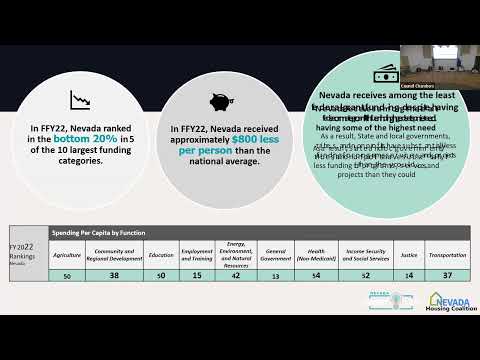
Turning to recent legislation, Page cited roughly 1,200 bill draft requests in the 2025 session, of which he said 63 related to housing; he estimated a roughly 40% success rate for housing bills and noted 26 housing-related measures were signed into law. He described Assembly Bill 540 as the largest housing measure: "This bill will represent a $133,000,000 coming out of our general fund," Page said, describing allocations he said include $83,000,000 for development of starter homes and two $25,000,000 components for down-payment assistance and eviction diversion programs.
Page also described the Nevada Supportive Housing Development Fund, which he said began as a one-time $32,200,000 appropriation in 2023 and will have a continuing $20,000,000 budget line to fund wraparound services for people living in supportive housing. He listed other legislative outcomes — tenant protections, manufactured housing measures and zoning changes — and cautioned that if state tax credits are not extended by 2027, affordable development could stall because credits serve as gap financing for many projects.
After his presentation, Commissioner McCullough asked how Fernley should balance added housing with infrastructure and worsening traffic, noting concern from residents. Page acknowledged the traffic problems, said planning and revenue identification are essential to match infrastructure with growth and offered to meet with the planning commission to help prioritize sites and funding options. Planning Director Michelle Rambo had introduced the presentation and framed it as background to bring the commission "up to speed on some of the current housing issues and some of the legislation."
The presentation provided commissioners with statewide and local housing metrics, summaries of recent bills and funding streams, and an offer by the Coalition to follow up with Fernley staff on coordinated planning and potential funding pathways.