Lifetime Citizen Portal Access — AI Briefings, Alerts & Unlimited Follows
Staff outlines new downtown density-bonus tiers and design standards; commissioners press for clarity on affordability and implementation
Loading...
Summary
Planning staff proposed two downtown density-bonus combining districts (DDB 400 and DDB 850), codified urban design standards to replace discretionary design-commission review, and a simplified affordable-housing/community-benefit structure; commissioners and stakeholders pressed staff on fee calibration, optional standards selection, and Phase 2 mapping.
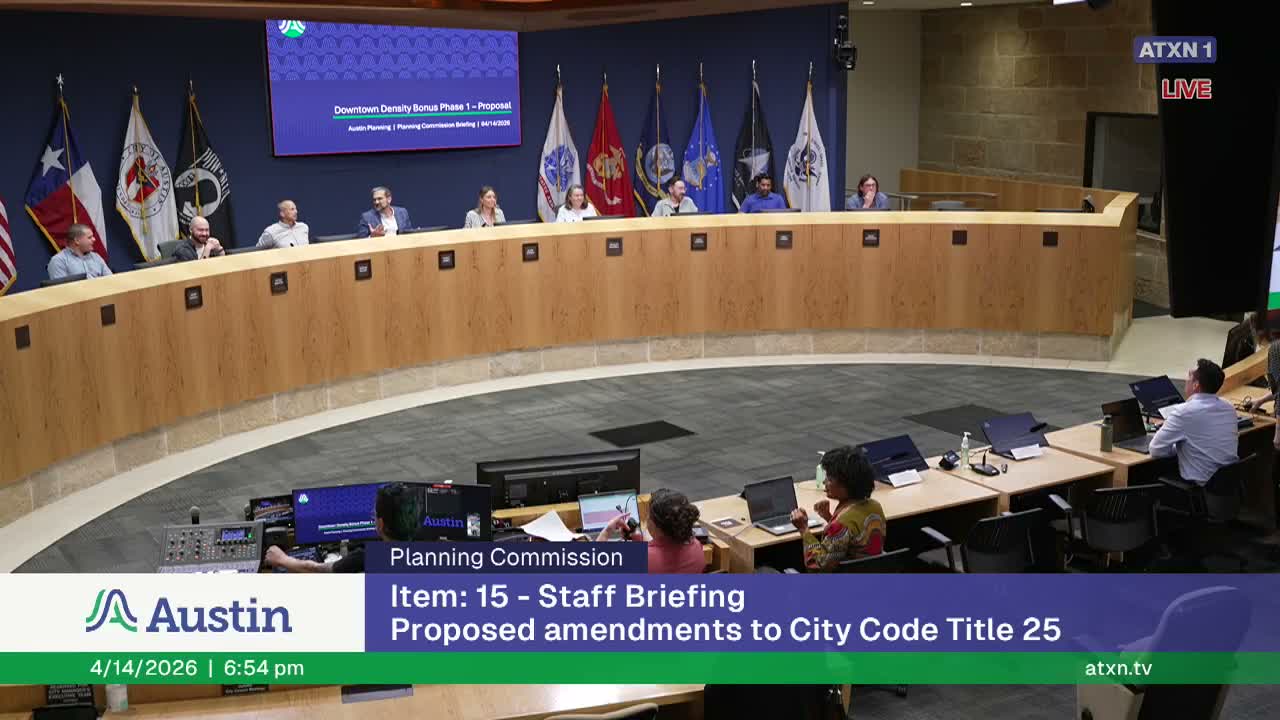
Planning staff presented proposed Phase 1 changes to Austin’s downtown density-bonus program, including a move from FAR (floor-area ratio) complexity to fixed height combining districts, new urban design standards, and a clearer affordability requirement.
Alan Pani of Austin Planning said staff proposes two combining districts — DDB 400 and DDB 850 — that would add fixed height allowances on top of existing CBD baseline heights, and that the city would rezone the Phase 1 geography into DDB 400 while applicants could seek rezoning to DDB 850 through the standard rezoning process. "Downtown density bonus will continue to be a voluntary program," Pani said, and staff explained the approach responds to council direction and an ordinance adopted in response to Senate Bill 840.
Staff emphasized codifying mandatory urban-design standards (screening for utility and above-ground parking, pedestrian-oriented frontage, primary entrances every 150 feet) and offering an optional list of standards from which projects must choose a set number (staff proposed 7 of 14 optionals for DDB 400 and 10 of 14 for DDB 850). The change would remove Design Commission review from the mandatory path and rely on site-plan review to confirm compliance. "Design commission would no longer be a part of this process and we're proposing urban design standards as opposed to that," Pani said.
On community benefits, staff proposed simplifying the affordability requirement: when using on-site units, projects must provide 5% of units at 50% MFI for rental or 5% at 80% for ownership; a fee-in-lieu option was presented as an alternative with a cited baseline of $10 per bonus square foot in some contexts. Pani said the fees were chosen with visibility to past market conditions and consultant analysis; he noted that under current market conditions "nothing pencils" and that fee levels were calibrated to be realistic given historic participation rates.
Commissioners and stakeholders pressed for more detail. Commissioner Ahmed asked whether optional standards might be weighted to avoid developers choosing lower-cost options; Pani said the list was developed with a working group and intended to be broadly applicable, but acknowledged some items may be chosen more often. Steven Buchanan of United Properties called the package a simplification but said he worried about downtown allowing fee-in-lieu rather than on-site affordability while more constrained subdistricts elsewhere would require on-site units.
Questions also focused on mapping and timing: staff said Phase 1 covers three subdistricts directed by council and that Phase 2 will return by the end of the year to address the remainder of downtown geography and potential additional combining districts. Staff said certain overlays, like the capital-dominance overlay, remain in effect (the capital dominance distance was noted as a quarter mile), and that coordination with central-city planning is ongoing.
Next steps: staff plans ordinances at the end of April and will return for May consideration and Council action ahead of the June 2026 direction; commissioners also approved formation of working groups to support further refinement of the downtown density-bonus and urban design guideline work.