Lifetime Citizen Portal Access — AI Briefings, Alerts & Unlimited Follows
Committee deadlocks on bill to delay Minnesota African American Family Preservation Act implementation
Loading...
Summary
A House Children and Families Committee tied 7-7 on motions to advance House File 4407, a bill that would delay and modify parts of the Minnesota African American Family Preservation and Child Welfare Disproportionality Act, after members clashed over synthetic-opioid removals, county costs and definitions such as "active efforts."
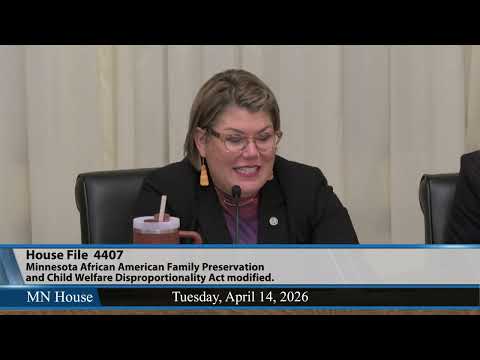
A Minnesota House Children and Families Committee deadlocked Thursday on efforts to advance House File 4407, Representative Dawn Gilman’s proposal to delay and amend the Minnesota African American Family Preservation and Child Welfare Disproportionality Act.
Representative Dawn Gilman, the bill’s sponsor, said the measure would delay statewide implementation by one year and make technical and operational fixes. "This bill is not about dismantling the Minnesota African American Family Preservation Act," Gilman said, adding the delay would allow the working group to finish recommendations and give counties more time to prepare.
Nonpartisan staff described the A1 author’s amendment as consolidating language from a DE1, modifying the definition of a "disproportionately represented child," assigning the determination to the commissioner of children, youth and families, updating training priorities and terminology, setting a working-group expiration of Dec. 31, 2027, and adding an appropriations section to fund statewide rollout.
County officials told the committee implementation would impose large costs and staffing needs. Steve Schmidt, Meeker County commissioner and vice chair of Minnesota Rural Counties, said MRC supports the bill as amended and urged a delayed statewide rollout so counties can staff, train and modernize systems. "We estimate our annual cost to be a half $1,000,000," Schmidt said when describing Meeker County's projected implementation burden.
Members pressed department officials on how the statute defines "active efforts," a term tied to how and when caseworkers attempt to preserve families. Commissioner Saint George said there is no absolute statutory definition and that, in practice, active efforts are evaluated case by case and often clarified in court. "It tends to be a case by case basis that it becomes up to the courts to help define for each case," Saint George said.
Several members warned the bill’s synthetic-opioid language could lead to emergency removals when a household contains nonprescribed fentanyl or other synthetic opioids. A member of the public, Jody McCarthy, asked whether the language might unintentionally penalize medication-assisted treatment; Gilman and the chair said the bill targets nonprescribed synthetic opioids and includes a rebuttable presumption allowing contesting removals.
Representative Hansen offered a DE1 amendment intended to align language with the Senate and Representative Esther Igbaje’s work; the roll call on that amendment was 7 ayes and 7 noes and it failed. Later, the committee took a roll call on the motion to refer HF 4407, as amended, to Ways and Means; the clerk recorded another 7-7 tie, and the motion did not prevail. The chair announced the bill would be laid over.
Supporters said the delay and funding language protect counties from an unfunded mandate and give the state time to centralize certain case-review responsibilities. Opponents said further delay risks postponing reforms targeted at racial disproportionality in child welfare and could be perceived as delaying benefits for Black children and families.
The committee did not adopt the DE1 amendment and did not refer the bill; members signaled willingness to continue negotiations, and the chair said additional committee work will continue.