Lifetime Citizen Portal Access — AI Briefings, Alerts & Unlimited Follows
Alameda planning board recommends updated inclusionary housing ordinance, asks staff to pursue in-lieu fee study
Loading...
Summary
The Alameda Planning Board voted to recommend that City Council adopt an updated inclusionary housing ordinance offering developers flexible compliance options, exempting projects of 11 units or fewer, and directing staff to pursue a formal nexus study and an in-lieu fee for larger projects within about a year.
The Alameda Planning Board voted to recommend that City Council approve a revised inclusionary housing ordinance that gives developers multiple ways to meet affordable-housing obligations, exempts projects of 11 units or fewer, and asks staff to pursue an in-lieu fee for larger projects pending a required nexus study.
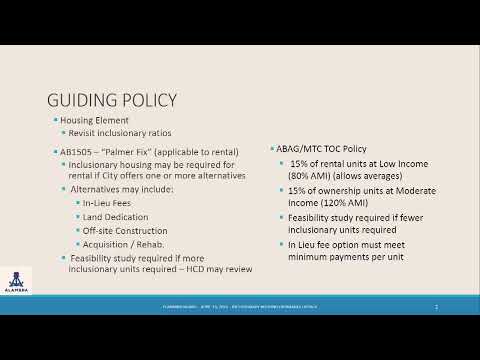
Steve Buckley, Planning Services Manager, opened the discussion by summarizing two years of work with consultants and subcommittees and reviewing the city’s housing-element goals. Buckley said staff is proposing alternatives to on-site units — including in-lieu fees, land dedication, clustered off-site projects and fee-based approaches — and noted the ordinance would authorize a fee to be set later by resolution once the required studies are complete. “We have committed to doing all of these things as a sort of all-of-the-above approach to meeting our housing needs,” Buckley said.
The board’s deliberations centered on several technical and policy questions. Members asked how the proposed local requirements would interact with the state density-bonus law, whether rounding rules for fractional units needed clearer language, and how in-lieu fees would be applied across project sizes. Buckley and the city attorney said the state’s density-bonus program uses different income-category thresholds than the city’s table, creating a mismatch that staff can clarify in ordinance language.
On legal risk, the city attorney told the board that a recent U.S. Supreme Court decision requires a clear nexus justification for exactions and fee payments, meaning an in-lieu fee would need a formal nexus study to be defensible. “There was a recent U.S. Supreme Court case that said that any exaction or fee payment had to be justified by essentially a nexus study,” the city attorney said; staff later estimated preparing that study could cost roughly $100,000 and take six months to a year.
Public commenters and a developer representative urged flexibility to keep projects financially viable and to avoid leaving built inclusionary units vacant. Sean Murphy, representing Pacific Development on the Alameda Marina project, said the Marina master plan includes about 801 units and that the Foundry project is approximately 260 shovel-ready rental units; he described operational changes the developer made to lease previously vacant moderate-income units and urged administrative options to avoid future vacancy.
Board members generally expressed support for the ordinance while asking staff to clarify several implementation details. In their recommendation to council, members asked that the ordinance: exempt projects of 11 units or fewer (raising the current exemption threshold), clarify cluster-development findings so a qualifying project need satisfy at least one finding, direct an administrative fix for existing developments with vacant moderate-income units within six months, and pursue adoption of an in-lieu fee for projects of 12 units or larger within about 12 months.
Board Member Wang moved the recommendation with those augmentations; Board Member de Weis seconded. The motion passed; the minutes record that there were a few abstentions and absences but do not list a detailed roll-call tally.
The planning board closed the item and advanced its recommendation to the City Council for final consideration. Staff said it will reconcile the board’s edits and return a consolidated package for the council’s review.