ARBC says 145-acre Upper Amite purchase is complete; $2 million NRCS boost and state bills could fund broader restoration
Loading...
Summary
The Amite River Basin commission reported closing on a roughly 145-acre purchase on the Upper Amite River to stabilize abandoned sand-and-gravel pits, announced a $2,000,000 NRCS federal appropriation for site work and highlighted pending state bills and capital-outlay requests that could create a dedicated river restoration fund.
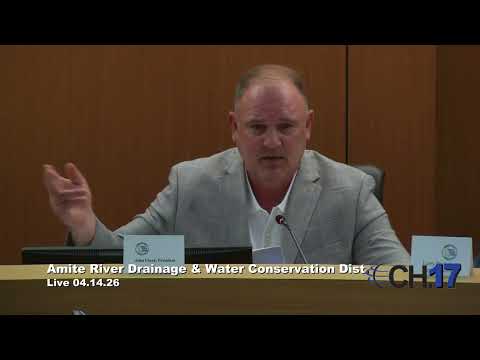
President Clark, who presided over the Amite River Basin Drainage and Water Conservation District meeting April 14 in Livingston Parish, said the ARBC has closed on about 145 acres on the Upper Amite River in Saint Helena Parish to begin restoring abandoned sand-and-gravel pits that contribute sediment and higher flood stages downstream.
In a report prepared for the board, Clark said the purchase is part of a larger Upper Amite River restoration effort “to acquire abandoned sand and gravel pits … and put it back like nature had it in its original state.” He added that the Natural Resources Conservation Service (NRCS) is slated to receive $2,000,000 through a federal appropriation secured by Rep. Letlow to help pay for site improvements and design work.
The funding announcement matters because the ARBC has an outstanding capital-outlay match requirement: Clark said the local sponsor match for capital-outlay funds is 25 percent, and that creative use of NRCS funds could help satisfy that requirement so the commission itself does not have to provide the match.
Clark also updated the board on several bills pending in the Louisiana Legislature that could affect long-term funding. He named Senate Bill 367, which would create a river-reservoir conservation fund supported by sand-and-gravel severance revenue, and House Bill 802, described as a similar river restoration conservation fund proposal. He also noted House Bill 899, a statewide sand-and-gravel oversight and regulation measure, and House Bill 493, which contains expropriation language the speaker said would affect the basin.
“The current bill is statewide on conservation and statewide revenue. The revision may refine the scope to just the Amite River Basin,” Clark said of HB 802, urging members that such legislation could provide a steady revenue stream focused on where sand-and-gravel fees originate.
Clark reminded commissioners that the ARBC previously received $2,000,000 in capital outlay that funded the recent property acquisition and that the commission has a prioritized capital request for an additional $67,000,000 (listed as P5). He suggested that showing success with the initial property purchase could help justify future appropriations.
Larry Bankston, ARBC legal counsel, told the board earlier in the meeting that letters were sent to the Saint Helena Parish assessor’s office asking that the newly acquired property be moved from the tax-exempt roll to the non-exempt roll and that the commission has contacted the insurer to confirm coverage going forward.
Why it matters: Stabilizing abandoned sand-and-gravel pits in the Upper Amite is intended to reduce sediment loads that worsen flooding downstream. The combination of a closed property acquisition, a targeted federal appropriation and pending state legislation could provide both project-level funds and a recurring revenue mechanism for future work.
Next steps: Clark said staff will continue planning, develop designs and consider other acquisition opportunities; the commission will monitor the progress of the named bills and capital-outlay appropriations. The ARBC plans to include FEMA updates and monthly reports in future task-force meetings to track mapping and modeling changes that may affect flood-insurance bases.