Lifetime Citizen Portal Access — AI Briefings, Alerts & Unlimited Follows
SEU director outlines 2026 pilot: solar-plus-battery systems for Bryant neighborhood
Loading...
Summary
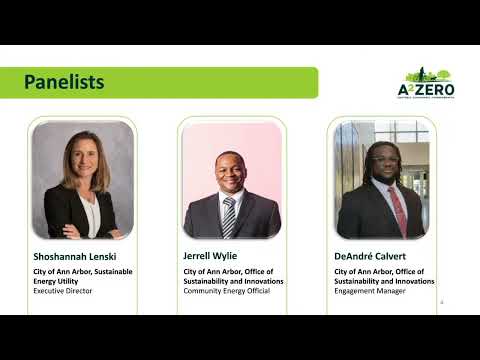
Shoshana Lenski, inaugural director of Ann Arbor’s Sustainable Energy Utility, said the city will pilot about 100–150 rooftop solar systems with batteries in the Bryant neighborhood in 2026, using grant funding for initial installs and seeking loans and rate revenue for broader rollout.
Shoshana Lenski, inaugural director of Ann Arbor’s Sustainable Energy Utility (SEU), told a public forum that the SEU plans to launch a pilot in 2026 that will install roughly 100 to 150 rooftop solar systems paired with batteries in the Bryant neighborhood and enroll those households as early SEU customers.
"We are a community owned, a municipal energy utility, and a utility of the future," Lenski said, describing the SEU as an optional, supplemental layer of clean energy service that sits alongside existing utility service rather than replacing DTE Energy’s grid. She said the SEU was authorized by voters in November 2024 and created by the city council in April 2025.
Lenski said the pilot systems will be behind the meter (serving individual homes), DTE‑interconnected, and that the city currently has grant funding to cover capital for that Bryant pilot. She said the SEU is pursuing additional grants and loan financing to scale operations and that the long‑term business model is ratepayer funded rather than paid through the city’s climate millage.
"The SEU is going to be a fee‑based utility, or a ratepayer‑based utility," Lenski said. She clarified that the city’s climate millage primarily funds other Office of Sustainability and Innovations programs and that the SEU may draw minimally from those funds during startup, but the intent is that SEU operations will eventually be covered by user fees and financing.
On customer interest and timing, Lenski said staff have an early list of about 1,500 people who have expressed interest and expect the pilot installs to begin in summer 2026 and go online by year‑end. She said full citywide offerings are targeted for 2027 as financing and operational readiness advance.
The SEU’s rollout is phased, Lenski said: Phase 1 focuses on rooftop solar and storage; Phase 2 will pursue neighborhood‑scale geothermal for heating and cooling (a longer design and construction timeline); and Phase 3 envisions microgrids or customer‑to‑customer sharing, which Lenski said will take several more years to materialize.
Lenski also described talks with DTE about aggregating pilot batteries into a virtual power plant so the batteries can provide grid resources during peak events. "DTE could say, ‘tomorrow at 4 p.m. we’re expecting really tight capacity on the grid — please discharge the batteries,’ " she said, as an example of how pilot capacity might be dispatched to lower system demand.
On pricing and billing, Lenski said rates are not finalized. Staff are leaning toward a capacity‑based fee rather than separate energy metering for each rooftop system to reduce metering complexity and infrastructure costs, but she cautioned that specific numbers are still under development.
The launch is small and intentionally iterative, Lenski said, and staff expect to learn operationally and pivot as needed. "We’re a baby, operating in really a start‑up environment within the city," she said, and asked for patience as the SEU builds toward larger scale.