Get Full Government Meeting Transcripts, Videos, & Alerts Forever!
Get email alerts on the Capacity Study topic
No spam. Unsubscribe anytime.
Consultants tell Greenwich elementary schools will average about 96% utilization; some buildings to exceed capacity
Summary
Consultants hired to validate district projections told the Greenwich Board of Education the district’s elementary schools are projected to average about 96% of planning capacity over the next five years, with several schools exceeding 100% and limited options to consolidate facilities.
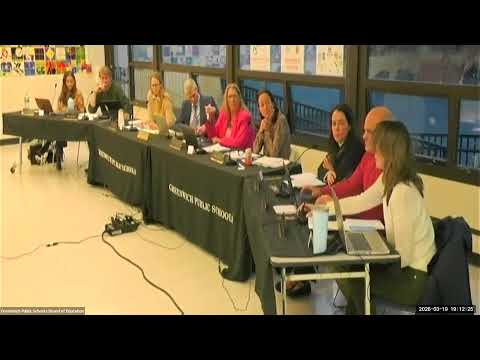
Consultants from M&P Planning Group told the Greenwich Board of Education on March 19 that, under the district’s planning assumptions, elementary schools will be well utilized — averaging roughly 96% of planning capacity over the next five years.
Pat Gallagher, one of the consultants, said the study uses an operational "planning capacity" (not a maximum physical capacity) that assumes class‑size loading levels and a 10% headroom deduction. "Districtwide, your schools are projected to be well utilized, averaging 96% of our planning capacity," Gallagher said. The consultants cautioned that planning capacity reflects ideal instructional operations, not the maximum number of bodies that could be crammed into rooms.
Why it matters: Several neighborhood schools are forecast to exceed 100% of planning capacity in some years, a condition that shifts pressure from classrooms to support services and can require year‑to‑year operational juggling. Gallagher and Mike Zuba, his colleague, flagged Glenville, North Marianas, North Street, Old Greenwich and Riverside as buildings projected to exceed planning capacity in coming years.
The consultants identified two primary short‑term relief points: flex classrooms and planned capital projects. For example, Parkway and Hamilton Avenue each include "flex" rooms that could be converted to K–5 classrooms without disrupting current operations; Parkway has two rooms reserved for future pre‑K expansion. Riverside’s planned expansion in the district’s capital plan is expected to add capacity that aligns with projected enrollment there.
Board members asked about options if buildings cross critical thresholds. Zuba said districts commonly use short‑term operational tools (adding sections, using flex spaces, micro‑redistricting, or portables) and longer‑term capital investments. "It really kind of depends on the pinch point — how long it lasts and how quickly you can plan and implement a response," he said. The consultants noted that once utilization exceeds about 110% of planning capacity, operational impacts become more severe and support services are likely to lose dedicated spaces.
Context and next steps: The study used a demographer’s 10‑year enrollment projections for context and focused on the first five years where birth and cohort data are more certain. The board will align the study results with its 10–15 year capital plan when setting priorities for renovations and additions. Consultants recommended using the study to inform redistricting, capital project phasing and pre‑K siting decisions.
Board follow‑up: Members asked the administration to share the report with Planning & Zoning officials so town development proposals can be evaluated against school capacity constraints. Administrators said they will bring the capacity study into fall capital‑budget planning and continue to monitor enrollment and utilization.
The consultants’ presentation and the board’s discussion ran through a series of slides describing methodology, flexroom inventories, program deductions for undersized spaces, and the five‑year projections; the board took no binding action at the meeting.