Council adopts housing-code updates to implement state housing element; council keeps local preferences and targeted inclusionary options
Loading...
Summary
The City Council approved code amendment 21-006 to implement the certified housing element, clarifying reasonable-accommodation procedures, removing subjective development standards, adding minimum densities in some zones, and allowing local preferences and specific-plan 15% inclusionary options; public commenters urged prioritizing affordability and preserving neighborhood character.
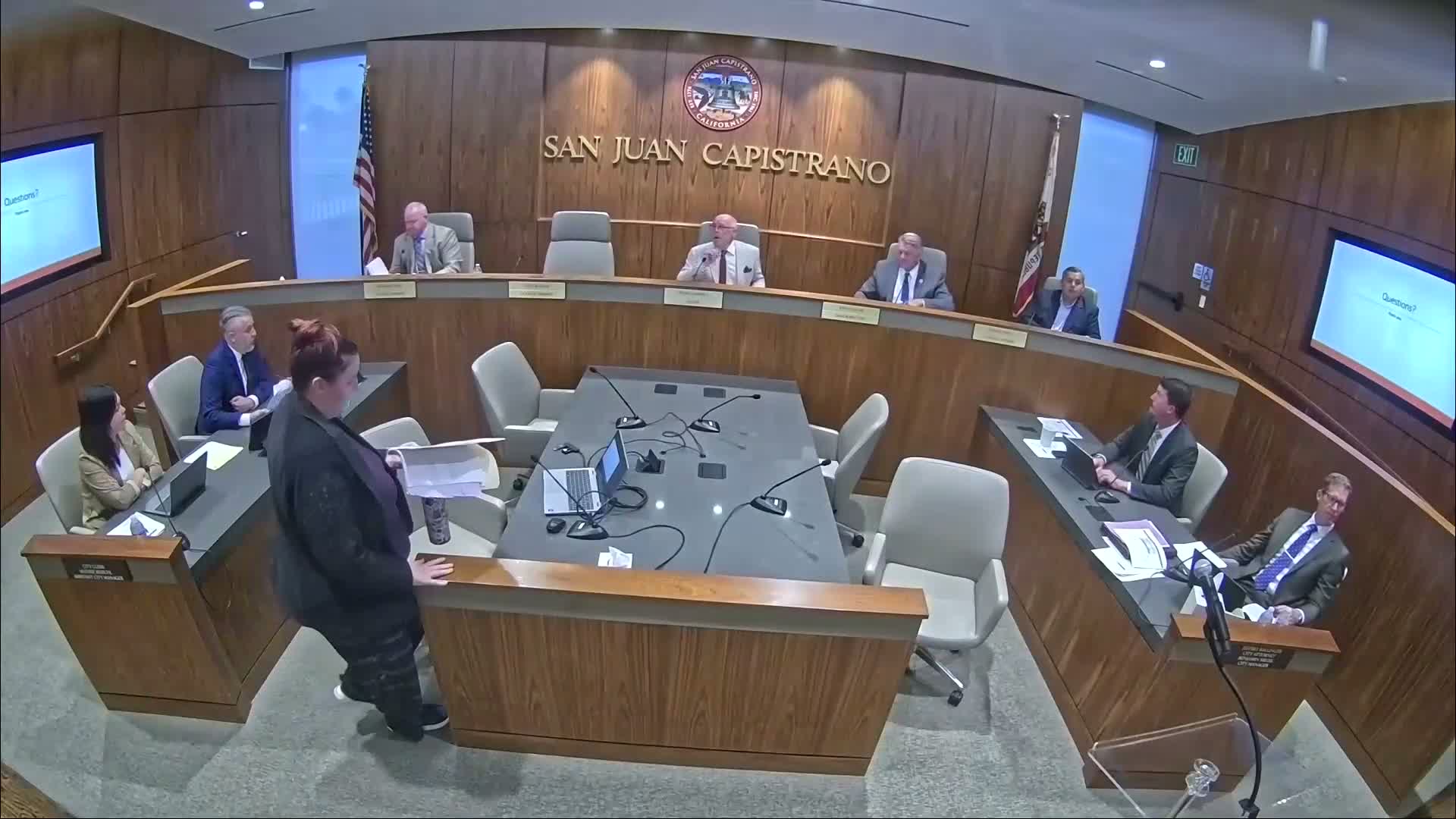
San Juan Capistrano City Council on April 7 introduced and unanimously approved ordinance amendments (code amendment 21-006) intended to implement the citycertified housing element and align local code with state requirements.
Planning Manager Laura Stokes presented a comprehensive staff report outlining proposed changes across multiple municipal-code sections. Key staff recommendations included:
- Codifying reasonable accommodations for individuals with disabilities in Title 1 so requests are processed under a clear, written procedure rather than ad hoc practice.
- Removing subjective standards that previously created inconsistent interpretations and replacing them with objective development standards where feasible, including specific changes in the Mission Residential District (revised second-floor setbacks and a lowered allowed height from 35 to 25 feet in that district).
- Permitting manufactured housing in the Mission Residential District and establishing a minimum density floor for very-high-density residential zones (no less than 18.1 dwellings per acre) so rezoned housing sites cannot be developed at much lower densities than allowed by the zone.
- Revising the industrial district language to set a minimum for farmworker employee quarters (36 beds or 12 units) consistent with state law.
- Restructuring inclusionary housing rules: keeping a baseline 10% inclusionary standard citywide while allowing targeted 15% requirements in specific plans, adjusting applicability thresholds (from two units to four), and switching the in-lieu fee formula to a per-affordable-unit basis rather than per-development-unit.
- Replacing the local density-bonus code with a direct reference to state law to avoid frequent local updates and ensure compliance with annually updated state provisions.
Stokes told the council that ministerial approval pathways would be expanded for rezoned housing-element sites that meet specified size, density and affordability thresholds so qualifying projects can proceed via building permits rather than discretionary entitlements.
Public comment highlighted trade-offs. Tony Lee, a resident and high-school student, said state compliance should not overshadow local affordability needs and urged prioritizing lower-income households, infrastructure readiness, and missing-middle housing. Architect David Ewing urged staff and council to reconsider the proposed 8-foot second-story side-yard setbacks on both sides (which he said produces only a 3-foot stepback in some cases) because of constructability and neighborhood impacts.
Council members pressed staff to delineate which provisions are state-required and which are local choices; staff identified local preferences (for example the local preference for initial affordable-unit tenanting to people who live or work in the city and where to apply 15%) versus items driven by state law (minimum densities, transitional-housing definitions, and certain parking/garage clarifications tied to state policy). Council discussion also covered density-bonus incentive levels and how higher inclusionary percentages can affect bonus concessions.
Following deliberation the council moved, seconded and approved the ordinance introduction by unanimous vote. The ordinance as introduced included a finding that no further environmental review is necessary under CEQA Guidelines section 15162. The city clerk read the ordinance title into the record and the council voted to adopt the code amendment as presented, with staff directed to proceed with implementation and to continue outreach to stakeholders.
What happens next: Ordinance adoption proceeds per the city's normal second-reading/administrative processes and staff will implement updated procedures, update fee formulas, and coordinate ministerial-approval pathways for qualifying housing-element sites.