Get Full Government Meeting Transcripts, Videos, & Alerts Forever!
Get email alerts on the Committee Actions topic
No spam. Unsubscribe anytime.
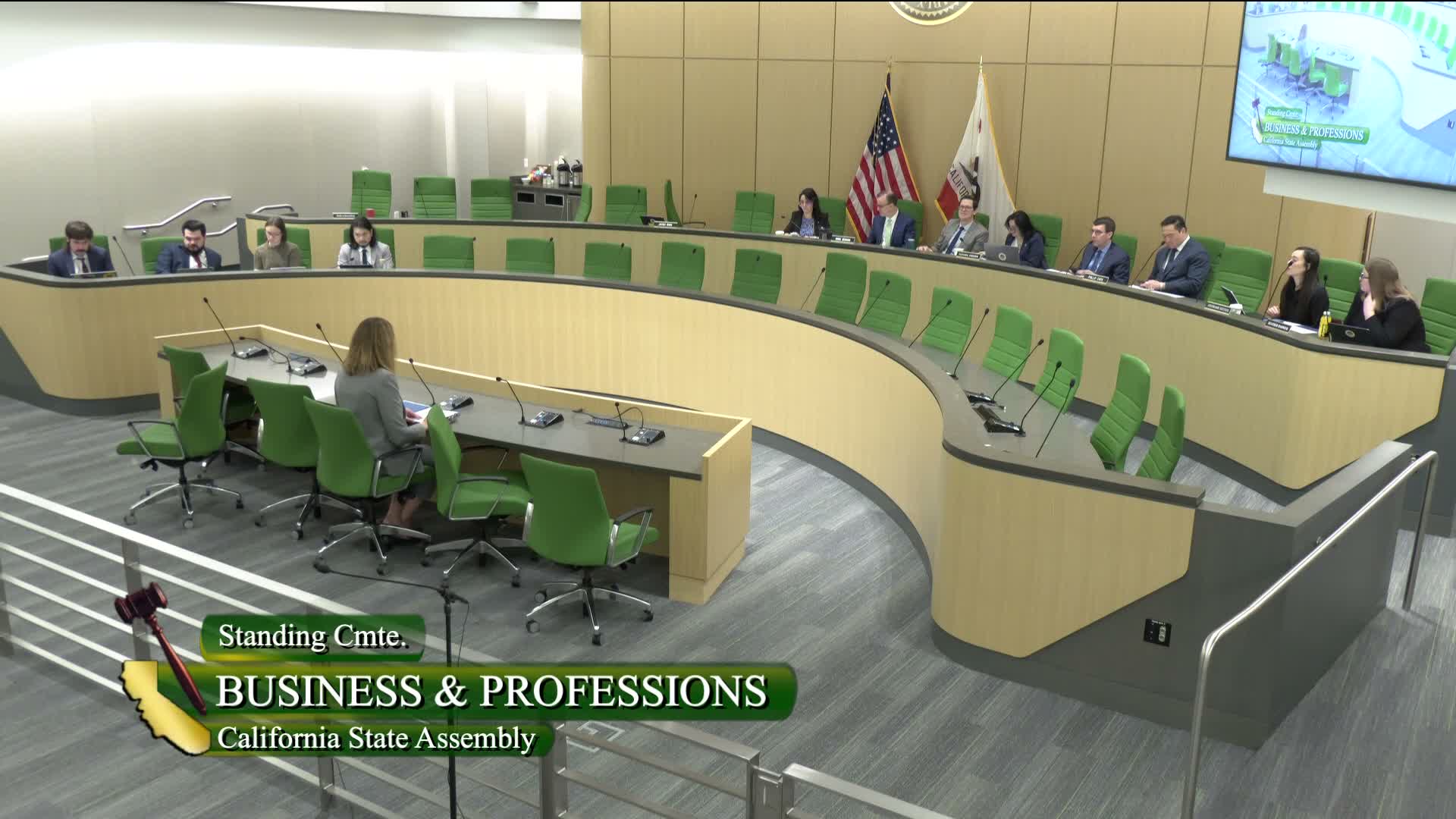
Assembly Business and Professions Committee advances a slate of bills on cannabis rules, consumer safety and health‑care protections
Summary
The committee advanced about 14 measures after testimony and amendments, moving multiple cannabis‑related bills (on enforcement priorities, packaging, and beverage serving sizes) and consumer‑protection bills for compounded drugs, pharmacy deliveries, veterinary care, and athletic‑pension funding to subsequent committees.
The Assembly Business and Professions Committee on an extended hearing advanced a set of bills covering cannabis regulation, patient protections and consumer rules.
The committee approved amendments and moved most measures forward after testimony from industry groups, public‑health experts and the state auditor. The panel accepted committee or author amendments on several bills and, once a quorum was reached, took roll‑call votes to report many measures to appropriations or other committees.
AB 25 37, authored by Assemblymember Chen, directs the Department of Cannabis Control (DCC) to adopt an enforcement‑prioritization policy that distinguishes minor, moderate and serious violations and requires annual reporting. Alex Friedman, president of the California Cannabis Operators Association, said enforcement resources are limited and called the illicit market “the greatest threat” to public safety and the licensed market, noting DCC analysis that “60% of cannabis consumed in California still moves through unlicensed channels.” He told the committee the bill does not strip DCC’s authority but provides statutory direction for prioritization.
The committee also debated AB 22 49, a measure by Assemblymember Erwin to define packaging and advertising elements that are “attractive to children” and to require a public rubric and a fee‑based packaging review process. Chris Applegate of the state auditor’s office told the committee the auditor found inconsistent DCC rulings and recommended clearer statutory definitions and a rubric; the bill implements many of those recommendations. Public‑health witnesses urged strict definitions, while industry and small‑farmer witnesses warned that a categorical ban on certain images could unintentionally prohibit legitimate branding and asked for transition periods and refinements.
On product safety for beverages, AB 25 32 (Erwin) would require visible serving‑size measures and clearer labeling for multidose cannabis beverages after the auditor’s review found containers with up to 100 mg of THC and no practical way for consumers to measure a single 10 mg serving. The committee accepted amendments and advanced the bill.
The hearing also moved several non‑cannabis measures. AB 19 90 (Gibson) would tighten testing, truth‑in‑advertising and documentation for compounded GLP‑1 injectable products after witnesses described adverse events and misleading marketing; supporters urged the bill as a patient‑safety measure, while compounding pharmacy representatives warned of potential compliance burdens and access impacts. The committee adopted clarifying amendments and passed the bill as amended.
AB 17 94 (Ransom) was amended to allow pharmacists and medical distributors to drop‑ship enteral (intra) nutrition to patients’ homes under pharmacist oversight; supporters described the change as essential for medically fragile Californians, particularly in rural areas. AB 24 02 (Burner) would update fee caps and definitions for multiservice health clubs; industry groups including Equinox and the Health and Fitness Association supported modernizing the statute. AB 19 99 (Calra) would expand pathways and volunteer status to address veterinary staffing shortages and narrow the owner exemption to exclude surgical procedures; broad stakeholder coalitions supported the bill.
Committee members and witnesses repeatedly framed the bills as balancing public‑safety goals with industry viability. Assemblymember Erwin said the packaging and beverage proposals reflect incremental progress after audit findings. Opponents across several measures urged careful drafting, transition timelines and attention to small businesses and pharmacy access in underserved areas.
What’s next: the committee reported most measures with amendments to appropriations or to the next policy committee for further consideration and fiscal review. Several authors pledged to keep negotiating amendments with stakeholders.