Get Full Government Meeting Transcripts, Videos, & Alerts Forever!
Get email alerts on the Coastal Restoration topic
No spam. Unsubscribe anytime.
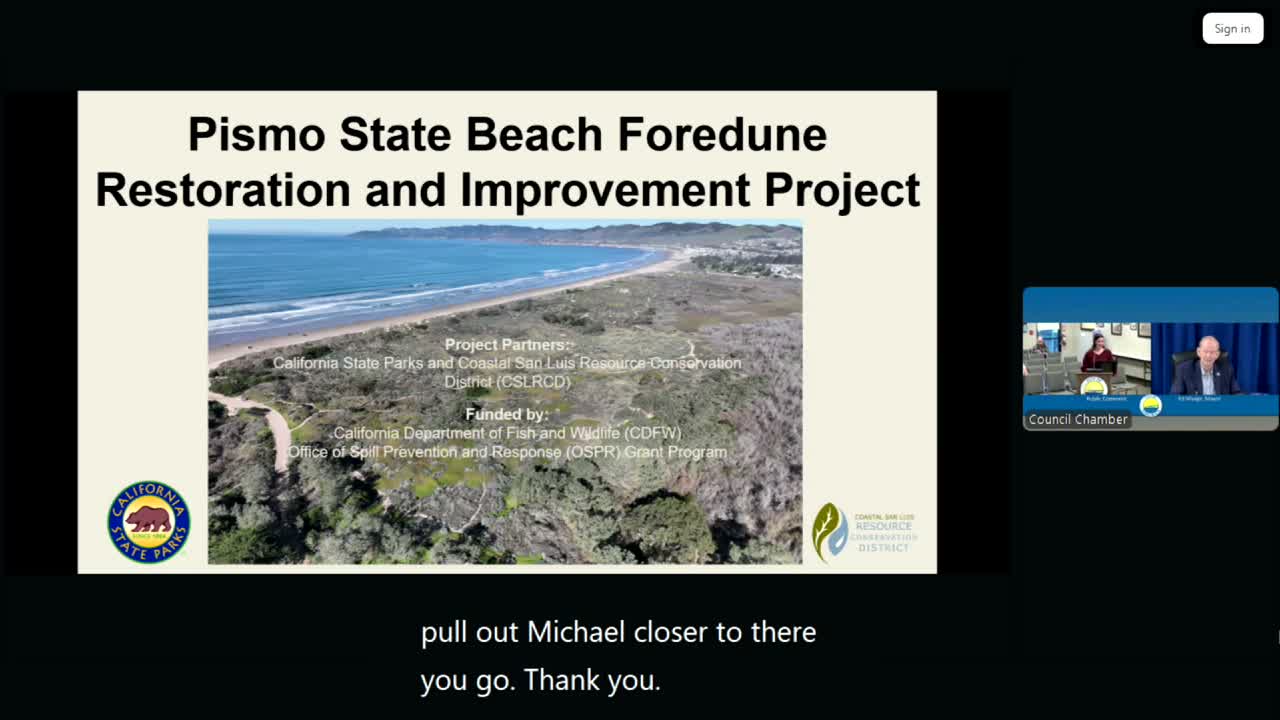
Coastal group outlines 5‑year, 151‑acre dune restoration at Pismo State Beach
Summary
The Coastal San Luis Resource Conservation District presented a five‑year plan to remove invasive plants and replant native dune vegetation across 151 acres of Pismo State Beach, aiming to strengthen habitat and shoreline resilience; funding comes from California State Parks and a CDFW grant.
A coastal restoration group outlined a five‑year, 151‑acre plan to restore the dune ecosystem at Pismo State Beach, removing invasive species and replanting native dune vegetation to improve habitat and shoreline protection.
Sam of the Coastal San Luis Resource Conservation District told the Pismo Beach City Council on March 17 that the project will first remove invasive plants such as ice plant, European beach grass and Acacia, then reestablish native species using locally collected seed to ensure genetic compatibility. He said the work is funded through California State Parks and a grant from the California Department of Fish and Wildlife.
"This project is really about helping our dunes function the way that they're supposed to," Sam said, describing the two‑phase approach of invasive removal followed by propagation and outplanting of native forbs, shrubs and groundcovers.
The project divides the site into four treatment areas with differing invasive pressures: Plot 1 (heavily dominated by ice plant), Plots 2–3 (mixtures of ice plant and European beach grass), and Plot 4 (dominated by woody Acacia). Sam said crews have begun invasive removal in Plots 2, 3 and 4 and plan follow‑up treatment and seed collection, with visible change expected earliest in Plot 4.
Council members and residents asked how long the work will take and where the funding comes from. Sam said the timeline is five years, that the RCD applied for and received CDFW grant funding, and that on active work days crews can number 30–40 people. He emphasized that all work will occur on State Parks property.
Council members and attendees pressed about methods and community outreach. The presenter described a combination of mechanical removal and targeted herbicide application depending on site conditions, along with temporary post‑and‑rope fencing and educational signage to protect young plantings and guide visitors.
Supporters at the meeting noted cultural and educational benefits as well as coastal protection. Maggie Wagner, a volunteer on local restoration efforts, said community donations and volunteer labor have already supported projects in Dinosaur Caves Park and urged continued recognition of volunteers.
The council did not take a vote; staff said they will return if additional council direction or permits are required. The RCD representative said he is available for follow‑up questions and thanked the council for the opportunity to present.