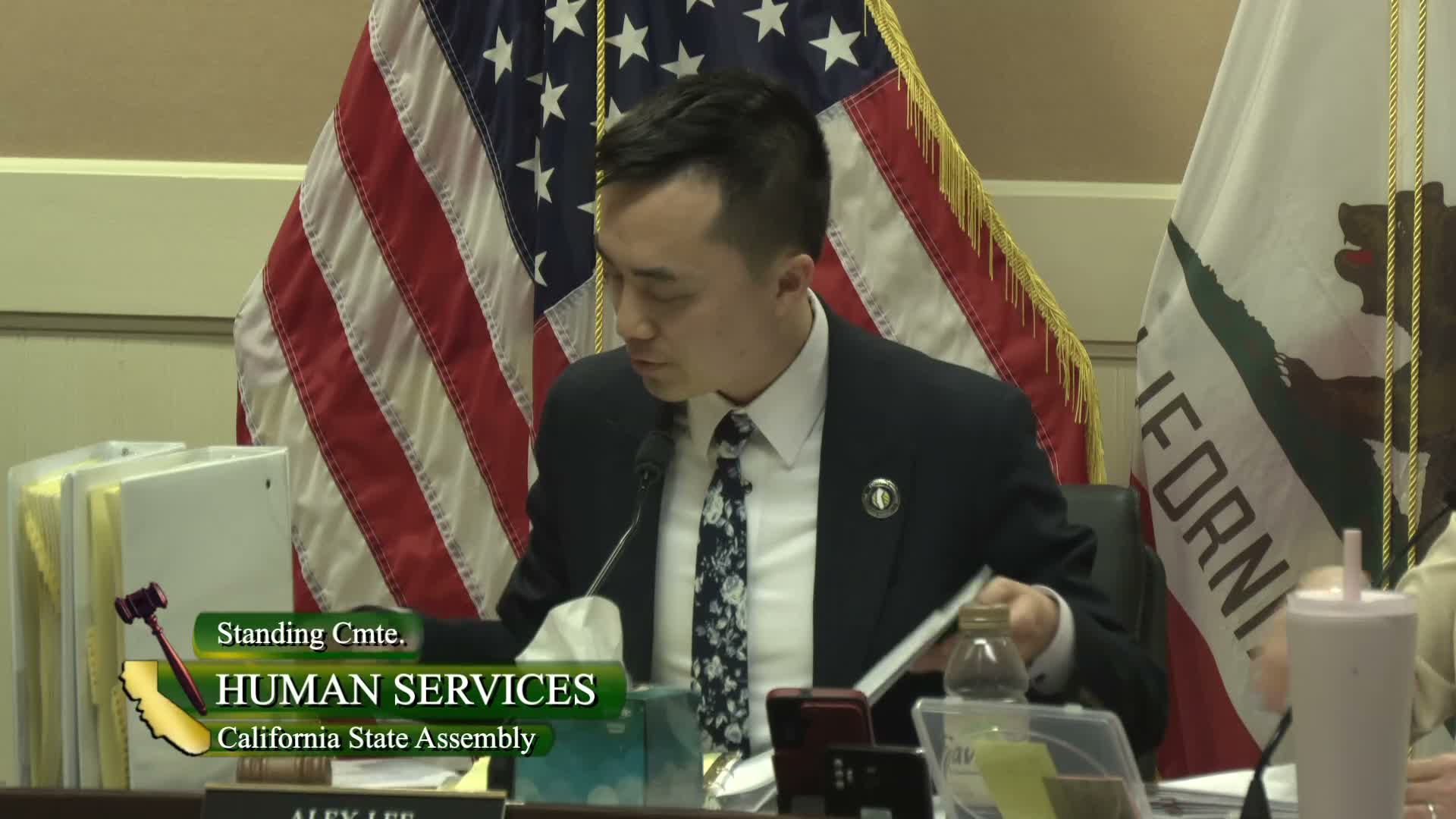
Assembly Human Services advances a slate of social‑services bills on respite, crisis response, housing and food aid
Loading...
Summary
The Assembly Committee on Human Services advanced multiple bills in a single hearing, including measures to expand person‑first language and community respite (AB 1575), continue community crisis response teams (AB 1932), extend housing navigation for former foster youth (AB 2162), and create a state response to CalFresh cuts (AB 2299). Authors and dozens of advocates testified.
The Assembly Committee on Human Services on Monday advanced a package of bills aimed at strengthening supports for people with disabilities, survivors of domestic violence, foster youth and Californians facing food insecurity.
Assemblymember Rebula opened the hearing with AB 1575, which would update the Lanterman Act’s references and change the definition of respite services to make community access — for example, trips to parks or neighborhood resources — an authorized option when safe and appropriate. ‘‘When you’re talking about me, please call me a person,’’ Jonas, who identified himself as a former executive director of People First of California and as a person with a developmental disability, told the committee in support. Alex Mountford, president of the California Respite Association, said the bill ‘‘provides clarity’’ for regional centers and does not add transportation or new rate costs to existing in‑home respite services.
The committee also heard poignant testimony on AB 1932 (the Scribe Act 2), which would continue and expand community‑based crisis response programs that send trained non‑police responders to behavioral‑health emergencies. Bridal Naranjo, who described the 2022 death of her father during a mental‑health crisis, told legislators that families need alternatives to law enforcement: ‘‘My dad didn’t need force. He needed care,’’ she said. A nurse and co‑creator of local response teams described cases in which crisis responders routed people to ambulances or urgent mental‑health care instead of arrest or jail.
Lawmakers considered several child‑and‑family bills. AB 2162 would extend the state’s housing navigation and maintenance program so supportive services can follow federal housing vouchers for former foster youth through age 28. Symone Turek Lee of John Burton Advocates for Youth said extending navigation ‘‘closes a harmful gap’’ between when federal vouchers become available and when state supports stop.
On workforce and supervision issues, the committee moved AB 2126, which creates a targeted background‑check exemption so current or former foster youth can be hired faster as peer partners in child‑welfare and behavioral‑health roles, while excluding violent and child‑related felonies, witnesses said.
The committee also discussed a major anti‑hunger response, AB 2299, designed to build a state bridge for people who will lose CalFresh benefits under recent federal time‑limit changes. Kois Satern of the Coalition of California Welfare Rights Organizations said hundreds of thousands could lose benefits and urged action: ‘‘This bill is that bridge.’’ Keelie O’Brien of the Western Center on Law and Poverty warned that nationwide research links loss of food assistance to worse health outcomes.
Near the end of the hearing, Assemblymember brought forward AB 2600, a proposal to establish a state‑funded right to counsel for Californians facing immigration removal proceedings. Supporters including representatives of Immigrant Defenders Law Center and the Vera Institute of Justice cited studies showing represented immigrants are far more likely to obtain relief. Opponents, including members of families who lost relatives to violent crime, objected to public funding for defense counsel in immigration proceedings and urged carve‑outs for people convicted of violent felonies; authors said they would not accept such a carve‑out and emphasized due‑process principles.
Votes at a glance: the committee moved a number of bills forward to the next committees (motions and roll calls were recorded on the hearing record for each file item). Several bills passed on unanimous or near‑unanimous voice/roll votes; details and the recorded roll calls are in the committee minutes.
What’s next: Bills the committee advanced will go to the fiscal or policy committees named on their file items (for example, appropriations, judiciary or education) for further hearings or budget consideration. The committee left several roll calls open for absent members and flagged some measures as going forward "as amended."