Lifetime Citizen Portal Access — AI Briefings, Alerts & Unlimited Follows
LAO urges caution as lawmakers probe scaling, accreditation and TA for community‑schools expansion
Loading...
Summary
At the hearing, the Legislative Analyst's Office warned that converting one‑time community schools grants into a $1 billion ongoing apportionment could undercut local flexibility and strain state capacity. Lawmakers pressed agencies on technical assistance staffing, accreditation design, and whether eligibility thresholds will unfairly exclude rural and non‑classroom‑based schools.
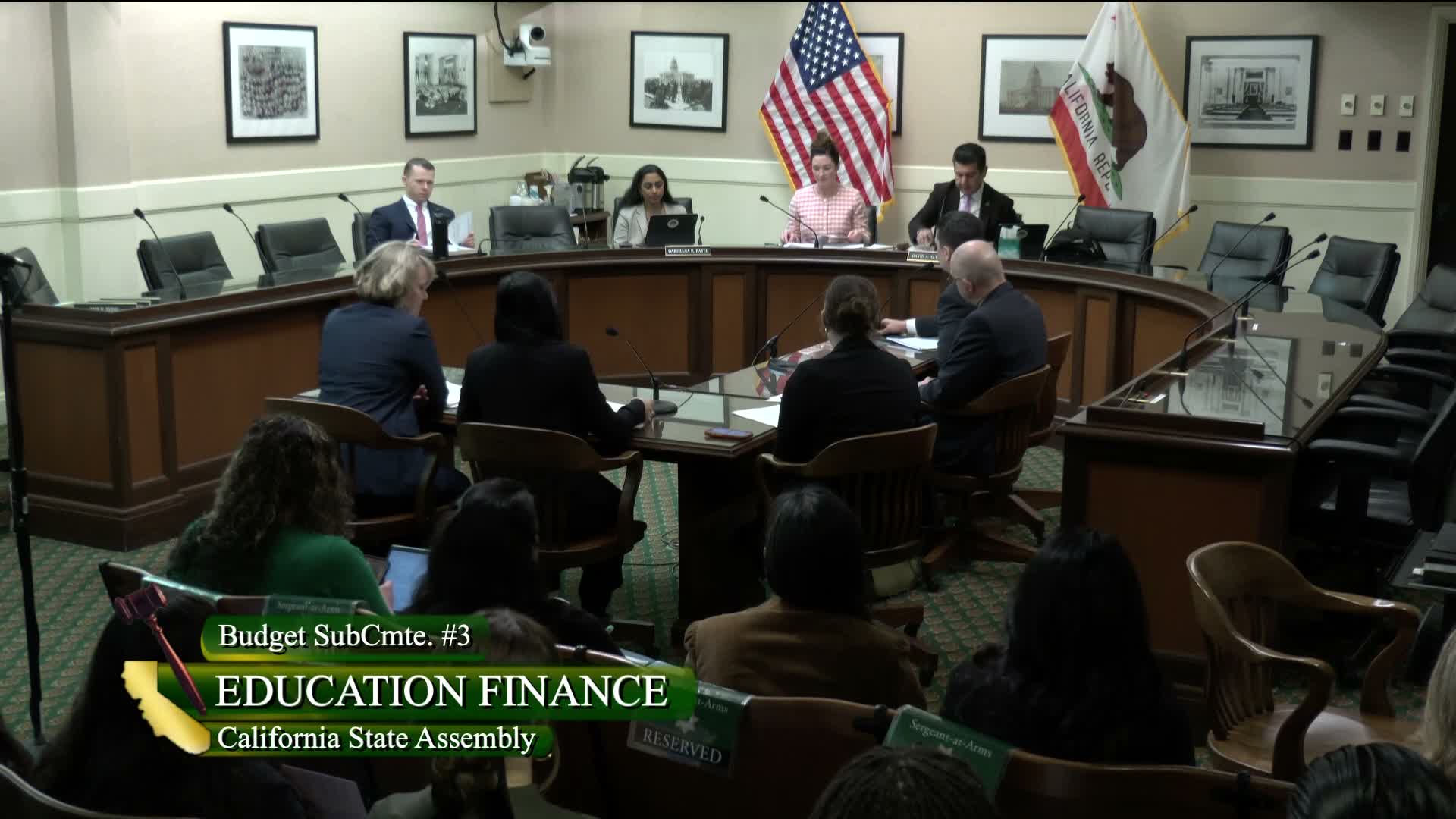
The Legislature's analyst told the Assembly subcommittee that while community schools show promising outcomes, establishing an ongoing categorical apportionment carries risks that require careful mitigation.
Michael Alferroz of the Legislative Analyst's Office told members the LAO "recommends that the legislature continue to fund community schools implementation with one‑time grants rather than provide ongoing funding as proposed by the administration." He argued a new ongoing categorical could reduce district discretion compared with the Local Control Funding Formula and could impose administrative burdens and reporting requirements that some districts lack capacity to absorb.
LAO analysts also identified specific implementation risks: (1) insufficient state capacity to support a sudden influx of thousands of new sites, (2) lack of detailed accreditation trailer language, and (3) gaps in planned annual reporting and earlier oversight that currently exist in the CCSPP competitive grant model. The LAO suggested alternatives including phasing eligibility, retaining multi‑year technical assistance funding, and establishing clearer timelines and draft criteria for any accreditation process.
Committee members and witnesses focused the conversation on technical assistance (TA). DOF and CDE said the budget includes a modest TA supplement (DOF cited $10 million ongoing targeted to STAC/RTAC support and an additional $13.3 million related to universal/targeted assistance funding), and that existing RTAC contracts (currently eight) provide an operating base. Witnesses cautioned those amounts may be inadequate to support a scaled program of 6,000+ community schools; several panelists advocated either larger TA allocations or a phased rollout to preserve fidelity.
Accreditation and self‑certification design drew sustained scrutiny. Panelists and members recommended the state develop accreditation criteria in partnership with education interest holders and existing accreditation bodies (for example, WASC), embed certification into existing reporting rather than layering new forms, and require early, funded stakeholder engagement. Several county office and district representatives raised the prospect that eliminating separate county coordinator funding in 2031 could weaken local ability to integrate services and coordinate supports for new sites.
The LAO also flagged equity and eligibility tradeoffs. If the state sets an unduplicated pupil percentage threshold (for example, 65%), that may concentrate access in higher‑need urban districts while excluding smaller rural districts that nonetheless face service gaps. Witnesses asked the Legislature to consider phased thresholds or protections for small and non‑classroom‑based charter providers who currently receive CCSPP grants.
The committee requested precise budgetary details in the May revise, including full breakdowns of TA staffing plans, how reverted extension funds might be repurposed, and draft accreditation timelines and estimated agency costs. The LAO and administration agreed to provide additional documentation.
No formal votes or statutory changes were decided at the hearing; discussion will inform trailer bill drafting and May revise budget decisions.