Get AI Briefings, Transcripts & Alerts on Local & National Government Meetings — Forever.
L&I outlines recent workers' comp bills, including PTSD pilot and access-to-care changes
Loading...
Summary
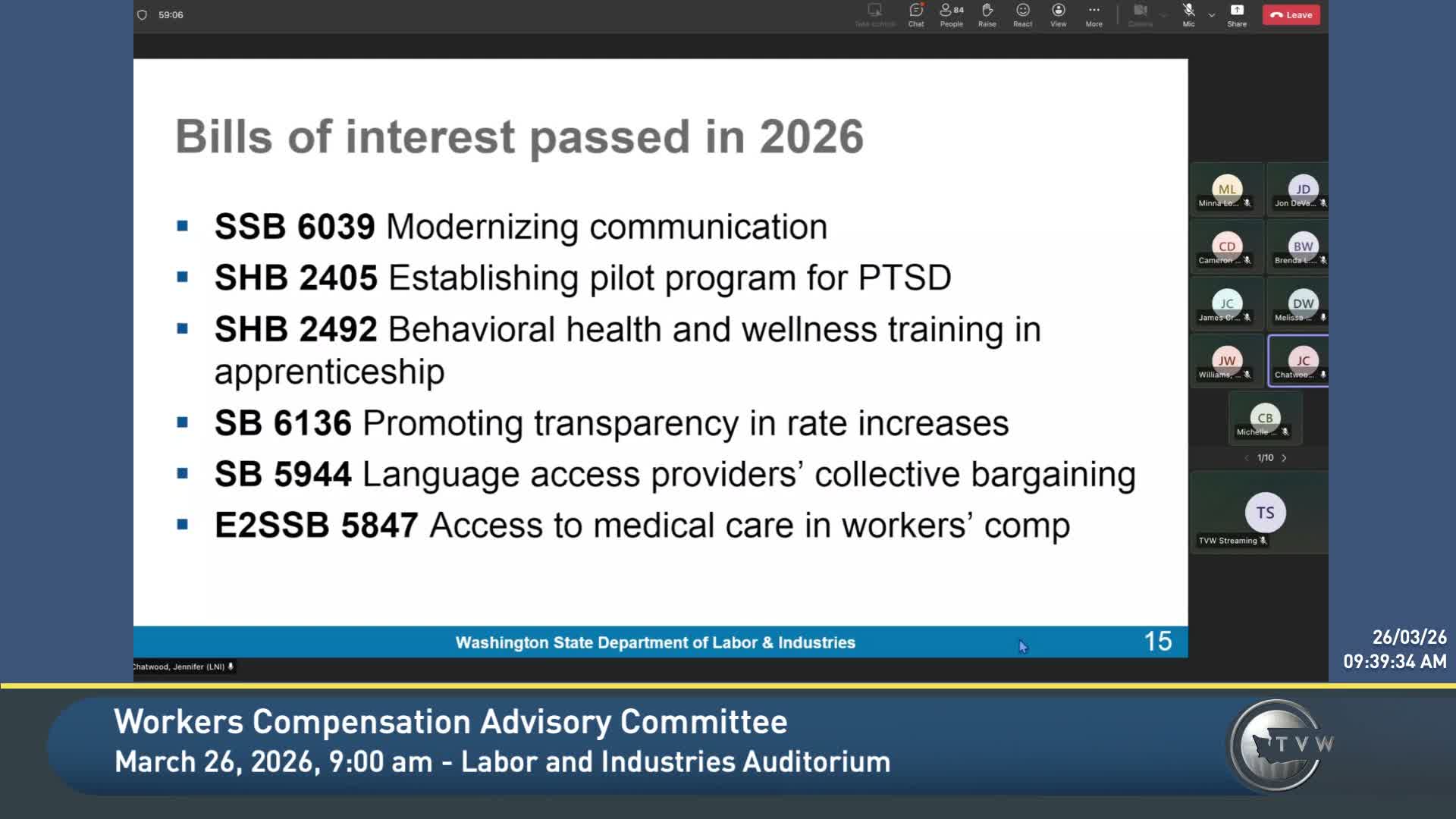
Cindy Gaddis summarized bills the agency tracked: HB 2151 (modular housing standards), HB 6188 (asbestos certification alignment), SB 6058 (wage-and-hour prioritization), SB 6039 (modernizing communications), HB 2405 (PTSD pilot) and a major access-to-care bill (SCS SB 5847) that expands treatment access and authorizes hiring claims adjudicators.
Cindy Gaddis, chief policy officer for Insurance Services, briefed the advisory committee on five agency-request bills the governor supported and several other bills that affect workers' compensation.
She said House Bill 2151 adopts national standards for modular housing and is signed into law. She reported HB 6188 (asbestos certification alignment with the EPA model accreditation plan) had been delivered to the governor but not yet signed. Senate Bill 6058 gives L&I authority to prioritize and proactively address wage-and-hour issues; Cindy said the governor signed it.
Cindy described HB 2405, an agency-request bill establishing a pilot program for PTSD occupational-disease claims. "There is some alignment with House Bill 2492, focusing on mental-health education in state-registered apprenticeships," she said, and noted the PTSD pilot includes research funding, expanded access to treatment before adjudication and after claim closure, and authority for L&I to enter into agreements with health-care organizations to increase trauma-informed care.
On medical access, Cindy discussed the large access-to-care package (referred to in the meeting as engaged legislation including SCS SB 5847). That bill includes many changes, several of which phase in by Jan. 1, 2028, giving L&I lead time to adapt systems. Two provisions take effect 90 days after session: (1) medical providers in networks must follow evidence-based coverage decisions "modified with the words medically appropriate," which gives providers some ability to deviate from prior guidelines, and (2) L&I can hire a significant number of claims adjudicators to reduce caseloads. The bill also creates deadlines for utilization-review providers and automatically grants treatment if outside UR does not respond in time; strengthens prohibitions on employer coercion to use specific medical providers; expands closed-claim treatment for workers with permanent partial disability awards; and requires written notice when a provider is removed from the medical-provider network.
Committee members asked for examples of how the new language "medically appropriate" might change care and about how the utilization-review contract will be negotiated; Cindy said the current UR contract expires in December and the agency will use that negotiation to put requirements in the new contract to meet the law. Members and staff said implementation work will include rulemaking and stakeholder engagement and that the committee will provide input on operational measures and hiring strategy related to the new adjudicator authority.
The committee did not vote on policy; agency leaders said they will return with implementation details and promised regular reporting to the advisory committee and the legislature, as required by law.