Get Full Government Meeting Transcripts, Videos, & Alerts Forever!
Get email alerts on the Occupational Health topic
No spam. Unsubscribe anytime.
L&I SHARP presentation links higher overdose and suicide rates to specific occupations
Summary
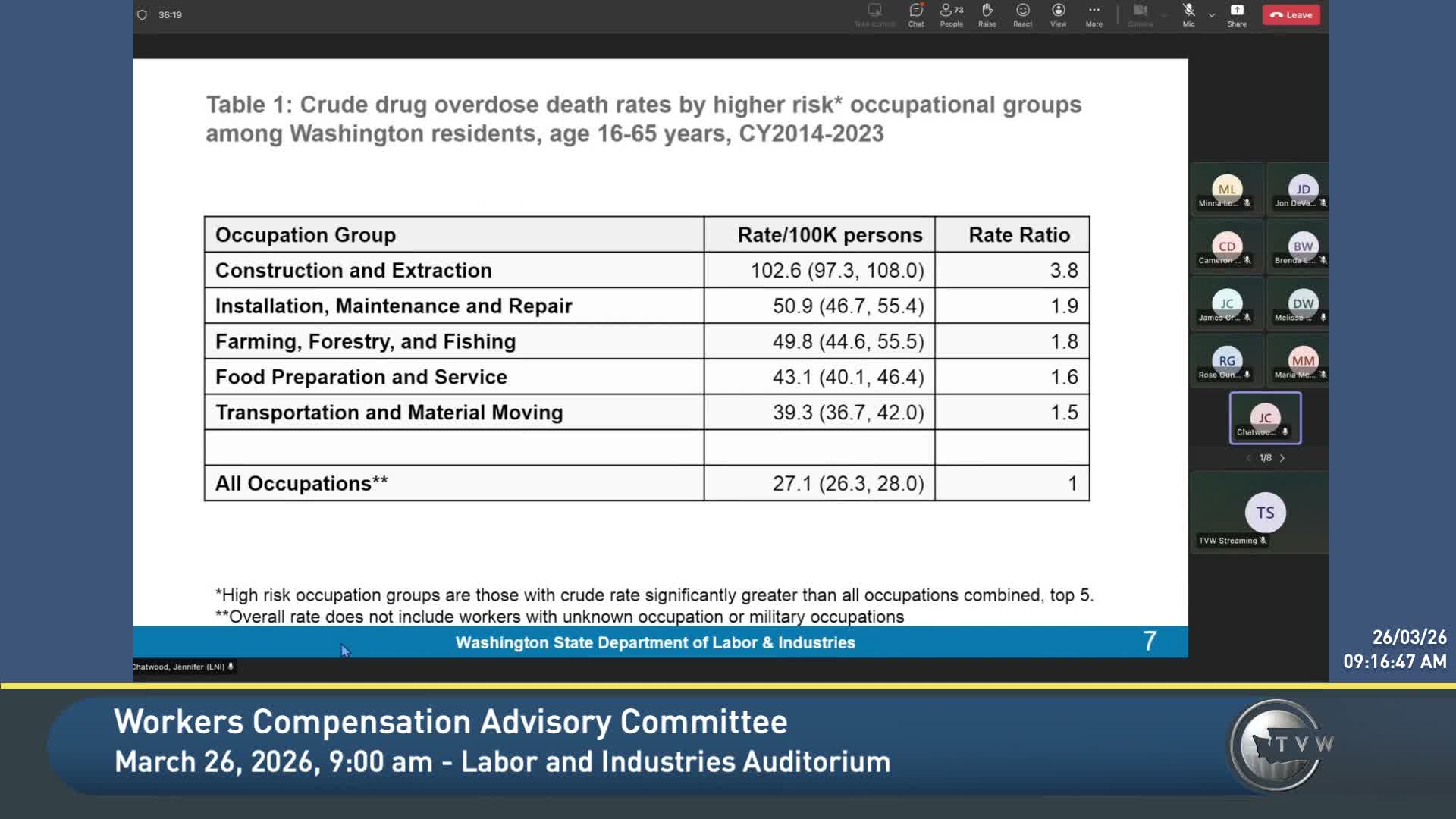
SHARP program lead David Bonato told the advisory committee that Washington death-certificate data show higher rate ratios for drug-overdose deaths in construction, installation/maintenance/repair, farming, food preparation and transportation occupations, and urged employers to address workplace injury, chronic pain and psychosocial stressors.
David Bonato, who leads the agency's SHARP research program, told the Workers' Compensation Advisory Committee that state data from 2014—2023 show elevated drug-overdose death rates in several physically demanding occupations. He singled out construction, extraction, installation and maintenance, farming, food preparation and transportation and material-moving roles as having higher rate ratios compared with the statewide working population.
Bonato said the trends reflect multiple phases of the opioid crisis: early rises in prescription-opioid deaths, a later increase in heroin deaths, and the more recent sharp growth in fatalities tied to synthetic opioids such as fentanyl. "As they did that in sort of 2011 ... there was a notable increase in heroin deaths and ... a later phase was sort of the introduction of fentanyl," he said.
He described workplace drivers that can increase risk, including workplace injury followed by prescribing for chronic musculoskeletal pain, job insecurity and time-pressured, low-control jobs that raise psychosocial stress. "If the paced work and you don't have the ability to modify the work ... that really is well correlated with the subsequent onset of depression," Bonato said.
Committee members pressed for more detail on factors such as shift work and gender differences. Bonato said his team uses death-certificate coding and denominators from the American Community Survey, and that the data can be drilled down to more specific occupations and demographic groups on request. He noted an observation that white non-Hispanic women show elevated risk in certain sectors and recommended sharing that finding with the national research community.
Bonato gave a brief list of practical employer actions echoed later by committee members: acknowledge mental-health challenges, train managers, reduce stigma, provide mental-health benefits and crisis-line access, and reduce preventable workplace injuries. He also reminded the committee that people in crisis can reach the national 988 hotline.
The presentation prompted follow-up questions about the causes of a recent drop in overdose deaths; Bonato said multiple explanations have been proposed, including wider naloxone availability, improved addiction treatment access and possible changes in the illicit supply, and cautioned against pinning the decline on a single cause.
The committee did not take action on the presentation but discussed how the SHARP findings could inform prevention and apprenticeship-training initiatives this year.