Get Full Government Meeting Transcripts, Videos, & Alerts Forever!
Get email alerts on the School Construction topic
No spam. Unsubscribe anytime.
Presenter says MSBA-defined 'code repair' would fix systems but not meet educational plan; estimated cost $437 million
Summary
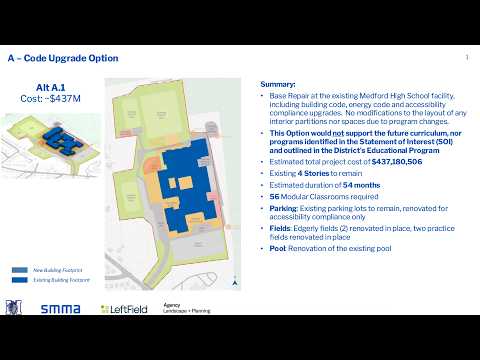
In a discussion of school-building options, presenters said Option A would repair code and accessibility issues required by the MSBA but would not add space or enable planned CTE expansions; they estimated a $437,000,000 cost and said MSBA reimbursement would not apply.
The moderator asked Matt to explain the A and B option labels and Matt said the “a options' were really' focused on a code‑repair scenario required by the Massachusetts School Building Authority.
Matt said Option A would address code compliance across the building's systems, including the exterior envelope, mechanical and electrical systems, and would also require accessibility upgrades inside and on the site, such as functioning elevators, accessible toilet rooms and regrading parking lots to provide accessible paths.
“The a options, were really I focused on, the code repair, scenario for the project,” Matt said, describing the option as a baseline assessment of what it would take to fix the existing structure.
When asked whether the building would look different after that work, Matt replied the building “would look exactly the same” because the approach focuses on repairing and rebuilding walls and systems in place rather than adding space or substantially reconfiguring the facility.
The moderator said the district's educational plan calls for program changes — including expanding career and technical education offerings by four shops to reduce wait lists — that Option A would not enable. The moderator added that, in that sense, Option A would not meet the educational plan.
Matt explained the MSBA would participate financially only when a proposed project meets the educational plan requirements; because Option A does not meet those requirements, MSBA cost‑sharing would not apply to this option.
The moderator emphasized the estimated price for the Option A scenario, saying the figure surprised attendees: “we would have to pay $437,000,000,” and noted that figure reflects work that would largely restore code compliance without delivering the planned program expansions.
The discussion framed Option A as a useful baseline for understanding what is structurally and legally required to bring the facility into code compliance, while also underlining its limitations in meeting programmatic and educational goals and in qualifying for MSBA reimbursement. Next steps discussed included further selection among the district's options and deeper conversations about trade‑offs when the group narrows choices.