Get Full Government Meeting Transcripts, Videos, & Alerts Forever!
Get email alerts on the Education Math Pd topic
No spam. Unsubscribe anytime.
Berkeley Heights math department proposes $17,500 professional-development plan to rebuild trust and consistency
Summary
Acting Superintendent Nixon hosted a 6–12 mathematics update in which Dr. Kelly Curtis and Alyssa Rush outlined a multi‑year professional development plan focused on rebuilding trust, balancing technology with direct instruction and improving small‑group interventions; year‑one costs total $17,500 and the district may tap Title II funds.
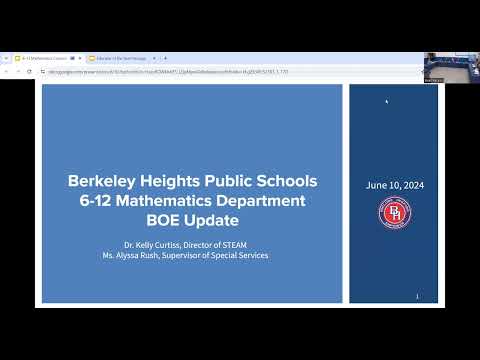
Dr. Kelly Curtis and Alyssa Rush presented a plan to the Berkeley Heights Board of Education to address parental and teacher concerns about secondary mathematics instruction and to rebuild trust in the district’s math program.
Curtis told the board the review drew on feedback from parents, teachers, PTO representatives, administrators and state assessment reports, and that the central themes were a need to repair relationships, balance instructional technology with teacher-led instruction and strengthen collective teacher efficacy. "A lot of the feedback...has had an expression of a loss of faith in the instructional program in mathematics," Curtis said.
The proposal centers on year‑one professional development delivered by a private consulting firm: two full‑day, in‑person trainings at the start of the school year, a parent‑facing "parent university" during the February PD day, five one‑hour follow‑up department meetings, and release time for collaborative planning. Curtis said the district would also conduct ongoing classroom observations to see the training implemented and would differentiate future training by teacher need.
Curtis described research that guides the work—citing John Hattie’s synthesis of instructional strategies—and emphasized that the plan focuses on targeted small‑group instruction and effective feedback. "Small group instruction is the piece that is missing in building thinking classrooms," she said, adding that teachers need training on formative assessment and on how to use data to plan interventions.
On cost, Curtis said the consultant contract is $15,000 and an additional $2,500 would buy teacher materials, for a first‑year total of $17,500. She cautioned that student textbooks were not included in that figure and estimated, based on district discussions, that providing textbooks for grades 6–12 could cost at least $500,000 and is not budgeted for 2024–25. She said the district would explore Title II funds as a possible funding source for the PD but that Title II is intended to support teachers and academic programs rather than to purchase student textbooks.
Board members pressed for specifics on timeline and classroom implementation. Curtis said the first full day of PD would be the second day in August, with follow‑up sessions during department meetings and ongoing classroom observation throughout the year; she called the work a multiyear effort and said the first year is a start toward a three‑year plan. When asked whether the district would prescribe a fixed percentage of class time for direct instruction, Curtis said she would not set a fixed percentage, arguing that teachers must retain the flexibility to respond to students’ needs.
Alyssa Rush highlighted special‑education considerations: some technology tools do not provide the necessary accommodations, and the training will include instruction on implementing specially designed instruction and IEP accommodations within the general education classroom.
Next steps Curtis outlined: finalize a contract with the consulting firm, confirm budget encumbrances with the business administrator, schedule the August training date, and continue the department‑level follow‑up sessions during the school year. The board did not vote on the consultant contract during the meeting; Curtis said she and Nixon would work with the business administrator on funding details.
The presentation concluded with board discussion and public requests for additional district comparisons and benchmarks; Curtis and Rush said they would follow up with additional detail to the board.