Get Full Government Meeting Transcripts, Videos, & Alerts Forever!
Get email alerts on the Enrollment Capacity topic
No spam. Unsubscribe anytime.
Lincoln Public Schools planning committee flags kindergarten decline, notes over-capacity elementary schools
Summary
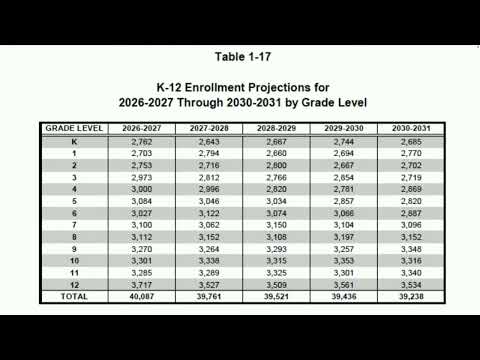
A planning committee presenter said kindergarten enrollment in Lincoln Public Schools is declining in line with local and national birth-rate trends, warned that sustained cohort losses could lower elementary enrollment, and recommended continued monitoring and a future high-school boundary review.
A presenter for the Lincoln Public Schools planning committee summarized the district’s facility-capacity and enrollment analysis and urged ongoing monitoring after a noted drop in kindergarten enrollment.
The presenter said the district’s statistical handbook shows 10 years of actual enrollment and projections across early childhood through grade 12 and described kindergarten as “always a question mark for us.” The report, the presenter said, uses cohort-based projections that count students currently in the system and therefore do not include new families who move to Lincoln.
The planning committee highlighted a decline in kindergarten relative to the eighth-grade cohort, noting the district typically gains roughly 150 students between eighth and ninth grade from other schooling settings. The presenter attributed the kindergarten decline to birth-rate trends in Lancaster County, the city of Lincoln and national patterns, and said net migration into Lincoln could alter projections.
On capacity, the presenter outlined a range of factors used to assess school space: number and size of classrooms, type and use of rooms, class size, programming and student needs. The district’s guidance triggers a deeper review when utilization shifts more than 15% from target. The presenter listed elementary schools exceeding 100% utilization without portables as Brownell, Clefkorn, Coosier and Lakeview and described portables as a useful, temporary tool that sometimes hosts family-service programs when buildings are full.
At the middle-school level, the presenter said the district has just over 9,000 students and that no middle school is above 100% utilization without portables; two middle schools — Goodrich and Skow — do use portables and will be watched as trends continue.
The planning committee’s next steps, the presenter said, are continued long-term monitoring of enrollment, especially kindergarten cohorts, and a request next year to review high-school boundaries in light of added portables and changing enrollment patterns. The presenter closed by inviting questions; none were raised.