Get Full Government Meeting Transcripts, Videos, & Alerts Forever!
Get email alerts on the Postsecondary Readiness topic
No spam. Unsubscribe anytime.
Quincy High outlines FAFSA push, student incentives and expanding dual-credit options
Summary
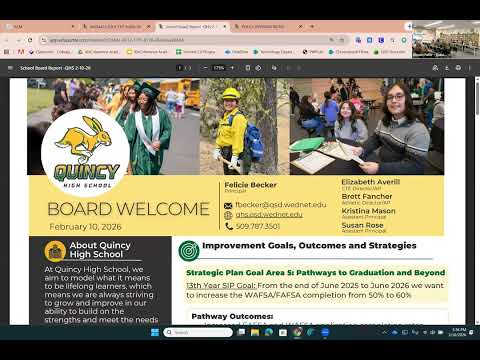
Quincy High School reported a FAFSA completion goal for seniors to rise from 50% to 60% (current ~52%), described targeted parent outreach, a district chatbot (JackBot) and incentive trips funded by Mariners Care, and said dual-enrollment offerings approach 170 college credits across partners.
Quincy High School presented a progress report on college and career readiness initiatives, including a district effort to increase FAFSA/WAFSA completion and expanded dual-enrollment offerings.
A high-school presenter (Speaker 3) told the board the district set a goal to boost FAFSA completion among seniors from 50% to 60% by next June and reported the current rate is roughly 52%. "Our goal... was from the June 2025 to this coming June, we wanna increase the FAFSA completion rate of our seniors from 50 percent to 60 percent," the presenter said.
To reach that goal the school has combined strategies: large parent nights, bilingual sessions, one-on-one outreach calls to families, and digital tools. The presenter described a custom chatbot, "JackBot," developed with WOSAC to give students FAFSA guidance tailored to Quincy. Staff from Big Bend (David Estrada and Michelle Delirosa) were credited with meeting seniors individually to support completion and track progress.
Incentives and partnerships: Mariners Care Foundation and Gates Foundation philanthropy were cited as partners; the Mariners' program will provide a trip to Seattle for FAFSA completers (game scheduled for April 20) and funding for buses. The presenter said the incentive has increased student engagement.
Dual-credit expansion: the presenter listed current college-credit capacity: Big Bend (18 classes, 77 credits), Wenatchee Valley College (7 classes, 33 credits) and articulated classes with Central and Eastern (totaling about 50 credits). "So right now, we are on the precipice of being able to offer 170 college credits for our students to take," the presenter said.
School supports: staff described targeted supports for at-risk students, student intervention specialists working with Tier 3 students (32 students currently), SmartPass digital hall passes, and disciplinary data showing declines in incidents of vaping and THC use compared with last year.
The board did not take action on the report; members asked for follow-up materials and praised student engagement programs and staff efforts.