Get Full Government Meeting Transcripts, Videos, & Alerts Forever!
Get email alerts on the Municipal Budget topic
No spam. Unsubscribe anytime.
First Selectwoman presents budget pitched as 'efficiency first' after $800,000 state revenue drop
Summary
First Selectwoman Ann Marie Dragonis presented a proposed budget that trims earlier requests to roughly a 2.9% town-side increase, citing an $800,000 loss in motor-vehicle reimbursement, $302,193 of unfunded state mandates to the town, and a list of deferred capital projects. She outlined personnel, equipment and capital needs and set dates for deliberations and public hearing.
First Selectwoman Ann Marie Dragonis told the Board of Selectpersons the proposed budget was built around one guiding principle: "efficiency first." She said departments were asked to review spending carefully and to focus on essential services while absorbing rising costs and changes in state funding.
Dragonis highlighted three budget drivers: an immediate need to fill staffing gaps (including adding a full-time assessor in preparation for a revaluation), a shortfall in patrol vehicles and equipment for public safety, and what she described as a roughly $800,000 annual loss in motor-vehicle tax reimbursement from the state. “Seymour previously received $800,000 annually from this program. Not anymore,” she said, adding the budget must absorb that reduction while maintaining services.
She also quantified town-side unfunded state mandates at about $302,193 — roughly a 1.85% impact — and said other mandates tied to the Board of Education have not been fully quantified. Dragonis noted the Board of Education requested a 4.3% increase and that the combined town-and-school picture shaped the overall mill-rate discussion.
Capital needs factored heavily in the presentation. Dragonis outlined a five-year capital plan that includes replacing patrol vehicles, buying turnout gear for firefighters, replacing a salt shed and several building repairs. She gave an example estimate of about $500,000 to resurface and repave Pearl Street and said ARPA funds were used previously to delay some capital but cannot be relied on indefinitely.
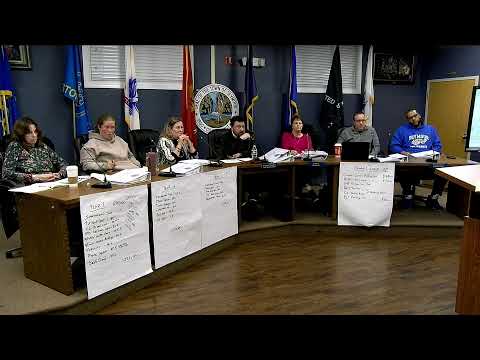
Dragonis walked the board through color-coded budget documents — blue items are untouchable, yellow indicates union-protected lines, orange indicates contract positions and green indicates shared services — and described line-item changes across departments including information technology, public works, emergency services and community services. She also described expected savings from reducing paper payroll processing and moving toward electronic pay statements; a shift to biweekly payroll would be contingent on aligning union contracts.
Board members asked for more granular bridging analyses comparing last year to this year, shared-services documentation and the insurance and payroll breakdowns; Dragonis and finance staff said that material would be prepared for a Wednesday deliberation. Board members also discussed economic-development strategy and the limitations of attracting major retailers without regional population growth.
Dragonis closed by stressing the trade-offs: she said she had trimmed a larger increase down to a roughly 2.9% town-side increase after cutting capital and other items, and warned the board that if voters do not approve the budget, the town will need to consider service reductions or other measures.
The board set a schedule for further consideration: a deliberation meeting on Wednesday, a second public hearing on Thursday at 6:30 p.m., and final deliberation and a recommendation to the annual town meeting on Monday, March 23.
What happens next: staff and selectpersons will produce requested line-item bridging and shared-services documentation ahead of the Wednesday deliberation; the public hearing will solicit resident input before the board’s final recommendation.