Get Full Government Meeting Transcripts, Videos, & Alerts Forever!
Get email alerts on the Political Polarization topic
No spam. Unsubscribe anytime.
Tyler Page urges moderation, listening and institutional fixes to ease U.S. political polarization
Summary
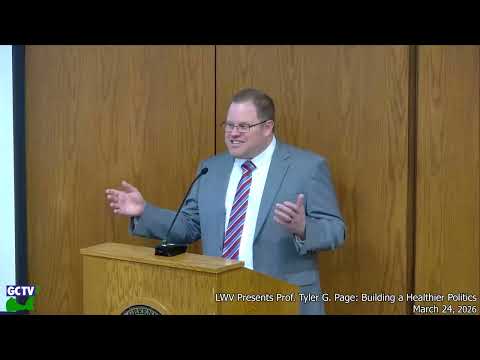
At a League of Women Voters of Greenwich forum in Greenwich, Tyler Page, an associate professor at the University of Connecticut, urged audiences to reduce polarization by seeking context, diversifying media intake, and pursuing institutional reforms such as remote voting and decentralizing congressional power.
Tyler Page, an associate professor at the University of Connecticut, told a League of Women Voters of Greenwich audience in Greenwich that political polarization in the United States is driven not only by policy differences but by widespread misunderstanding and incentives that reward extreme rhetoric and narrow victories.
Page framed the problem as threefold: U.S. institutions encourage gridlock, citizens and leaders no longer prioritize persuasion, and partisan media and social algorithms amplify the most extreme portrayals of opponents. "If it sounds ridiculous, it is probably misunderstood or exaggerated," Page said, urging listeners to check primary sources and delay immediate reactions.
He illustrated how misunderstandings become entrenched with examples from immigration debates and the public reaction to the Green New Deal, saying the same proposal can be read as a pragmatic starting point by supporters and as an apocalyptic spending plan by opponents. He also used a personal anecdote about a woman with severe epilepsy to show how context changes the meaning of actions and statements.
Page recommended practical steps for citizens and institutions: wait before responding to inflammatory claims, consult original sources, diversify media consumption, and ask clarifying questions to understand the interests motivating opposing positions. On gun policy he argued that acceptance of some measures depends on "social trust" — when communities trust each other they are more willing to accept checks such as background checks.
Turning to institutional reform, Page proposed ways to strengthen accountability and broaden participation in Congress: reduce centralized control in leadership offices, encourage representatives to remain rooted in their districts, enable remote voting so members do not have to spend the week in Washington, and consider campaign funding rules that focus donations on the elected officials a donor can actually vote for.
During a question-and-answer session, audience members pressed Page on federal-state interactions, how to respond to morally intolerable political speech, and how to promote healthier campaigning. Asked about aggressive executive actions, Page said media incentives often drive leaders to grandstand and that coordination with states and better institutional checks can reduce reactionary policies. When a questioner raised a recent example of a president praising a death, Page said he found the remarks "appalling" and said prominent figures should be universally called out when they cross moral lines.
Page closed by offering a set of practical rules and a civic ethos: respect fellow citizens, listen to understand their underlying interests, and seek compromises that satisfy large parts of both sides. "I wait 24 hours before I respond," he said, describing that pause as one of his habits for reducing escalation.
The League recorded the event and GCTV provided a livestream; Page said he would take questions after his prepared remarks and shared a list of suggestions he had discussed during the talk.