Get Full Government Meeting Transcripts, Videos, & Alerts Forever!
Get email alerts on the Housing Rehabilitation topic
No spam. Unsubscribe anytime.
Biloxi council leans toward citywide housing‑rehab program, sets funding parameters
Summary
At a special-called workshop, Biloxi councilmembers gave staff direction to pursue a citywide CDBG-funded housing rehabilitation program (with written stipulations), sketched an illustrative $500,000 budget and proposed per-household caps (minor $10,000; major $25,000). Flood‑insurance requirements and federal compliance questions remain.
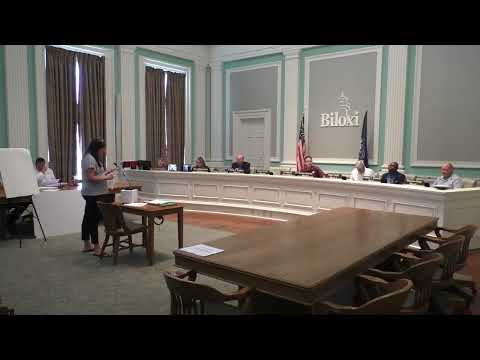
At a special-called workshop to shape a proposed housing rehabilitation program, the Biloxi City Council on Monday gave staff high-level direction to develop a citywide low/moderate-income program with written stipulations to limit assistance to those most in need.
Paula Snyder, city housing staff, told the council the program would be part of the city’s Program Year 2026 annual action plan and must be entered into the HUD system on a tight schedule. "This is an overview," Snyder said, noting staff would begin required public notices and hearings and that elements omitted now might require later amendments that could delay spending.
Council members agreed on several illustrative budget and design parameters to guide staff: they used an example allocation of about $500,000 (roughly $400,000 in federal CDBG funding plus roughly $100,000 in variable program income), with up to 15% earmarked for public‑service partners and up to 20% of the balance available for administrative costs. Using those assumptions, speakers estimated roughly $300,000 would remain for direct housing repairs.
On per-household limits, councilmembers sketched a distribution that would prioritize minor repairs while reserving funds for larger projects. "Sixty percent minor with a maximum cap of a minor at $10,000 and 40% major with a maximum cap of $25,000," a council member summarized during the discussion. Councilmembers emphasized these caps are illustrative and depend on the city’s final allocation and required environmental and lead‑paint remediation costs.
The council debated whether eligibility should be targeted to HUD‑identified low/moderate‑income census tracts or opened citywide to all qualifying households with written stipulations to exclude high‑equity homes. Supporters of the citywide approach said it would ensure anyone who qualifies under HUD income limits can be considered, while others cautioned that precise stipulations are necessary to avoid funds going to households with significant equity.
Flood‑zone eligibility and insurance emerged as one of the meeting’s thorniest issues. Snyder and other staff explained that some peer cities exclude properties in flood zones or require homeowners to obtain flood insurance; if a rehabilitated property lacked required insurance and later suffered damage, the city could face federal repayment obligations. Councilmembers asked staff to research whether program choices could affect Biloxi’s Community Rating System (CRS) flood‑insurance rating and requested documentation on the potential insurance‑rating impacts.
Council discussion also covered the forgivable‑loan monitoring period (how long the city would require homeowners to keep insurance and other conditions before the grant is forgiven). Staff recommended a conservative, HUD‑aligned approach; an experienced staffer noted that three years is commonly treated as reasonable for monitoring, while five years is more protective for the city but harder for homeowners.
Staff and council set the next steps: additional workshops, answers from staff on CRS/insurance impacts and regulatory constraints, and engagement with the public at two scheduled hearings (May 20 and June 23) to solicit input. A three‑member committee volunteered to refine the program details and meet with staff before the next workshop.
No final policy was adopted at the workshop; the council’s guidance asked staff to prepare a draft annual action plan submission that reflects citywide eligibility with stipulations, the illustrative budget and the proposed per‑household caps, and to return with documentation on flood‑insurance and HUD compliance.
Actions at the meeting were procedural: the council approved the meeting agenda at the start of the session and later voted to recess/adjourn at the close of the workshop. The council will reconvene in future workshops to finalize the program.