Get Full Government Meeting Transcripts, Videos, & Alerts Forever!
Get email alerts on the Land Use And Local Economy topic
No spam. Unsubscribe anytime.
Corrales council rejects Arts & Cultural District authorization after hours of public comment
Summary
After a 30-minute public comment period with strong views on both sides, the Corrales Village Council voted 2–4 to reject a resolution to adopt an Arts & Cultural District economic plan, with opponents citing water, traffic and infrastructure concerns and supporters saying the plan only provides tools and funding options.
The Corrales Village Council voted down a resolution to adopt Corrales Main Street's Arts & Cultural District (ACD) economic development plan after extended public comment and council debate.
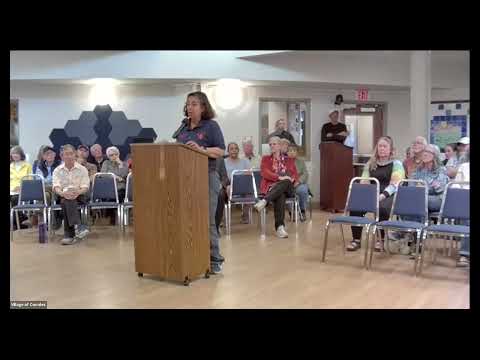
The vote concluded after residents filled the public comment period with mixed testimony. Sabine Schroeder, who lives adjacent to the mixed-use commercial area, urged the council to reject the plan, citing increased noise, inadequate sewer infrastructure and wildfire-evacuation safety risks. Jolene Mays, a 53-year resident, asked the council to defer action until the village's comprehensive plan is completed and approved, saying the ACD conflicts with draft comprehensive-plan language that aims to protect adjacent residential neighborhoods.
Jim Krueger, president of Corrales Main Street, told the council the ACD is a “road map” that does not itself mandate action, and that it does not supersede the comprehensive plan or local ordinances. Angela, who identified herself as an executive director involved with the ACD application, said many activities would continue with or without ACD authorization and highlighted potential benefits such as eligibility for double historic tax credits for building owners within the district.
Council debate centered on whether the ACD's language — including words such as “revitalization” and “transformation” — was appropriate for Corrales, whether the ACD aligned with the pending comprehensive plan (particularly goal 3-6), and if agricultural heritage was sufficiently recognized. Councilor Alserbrook argued the plan's wording carried a top-down national Main Street template that risks long-term change in village character; Councilor Knight and others said the ACD provides tools to help small business owners access grants and tax credits.
After discussion and recorded roll-call votes, the council recorded two yes votes and four no votes. Councilor Burkett and Councilor Knight voted yes; Councilor Murray, Councilor Osselbrooke, Councilor Wolman and Councilor Miera voted no. Mayor Ron announced the ACD resolution failed.
With the resolution defeated, council members and residents said they expect continued discussion about how to reconcile economic-support tools with protections for the village's rural character. The council did not adopt amendments at the meeting; several councilors suggested edits and possible future motions if the ACD or parts of it are brought back later.