Get Full Government Meeting Transcripts, Videos, & Alerts Forever!
Get email alerts on the Environment Shoreland topic
No spam. Unsubscribe anytime.
DNR hydrologist urges shoreland buffers as Brainerd agrees to keep negotiating
Summary
Minnesota DNR area hydrologist Jake Free told the Brainerd Planning Commission that protecting near‑shore vegetation reduces phosphorus and algal growth; commissioners directed staff to continue negotiating DNR shoreland requests rather than immediately adopt or reject them.
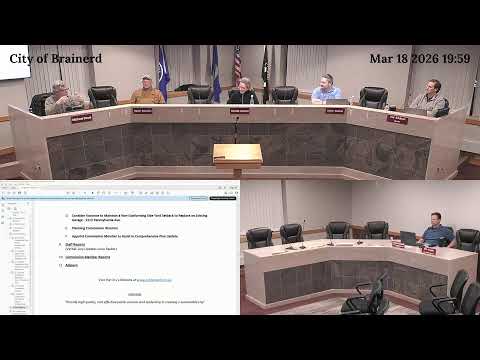
Jake Free, an area hydrologist with the Minnesota Department of Natural Resources, told the Brainerd Planning Commission on March 18 that the state has lost roughly 40–50% of its natural shorelines and that restoring near‑shore vegetation yields outsized water‑quality benefits. Free said studies show watersheds with more than 25% development experience significant phosphorus increases, and he described two regulatory triggers the DNR recommends: requiring a stormwater management plan for properties with more than 15% impervious surface, and requiring a vegetative buffer for properties with more than 20% impervious surface.
James, city staff, told the commission staff had asked the DNR whether lot sizes and impervious limits might be negotiable for certain non‑riparian lots and that the DNR had responded with the recommended triggers and additional limitations on riprap. Free said the proposed offsets — such as buffers and modest stormwater plans — were practical, often inexpensive for property owners, and effective because they target the critical interface near the water.
Commissioners pressed on implementation details and local effects. Several members said Brainerd’s municipal sewer system and sandy soils reduce some septic‑related loading, and that much of the overall watershed and sources of phosphorus lie outside city jurisdiction. Commissioners discussed Gilbert Lake and Rice Lake specifically, noting that parcels inside the city and other jurisdictions will have different impacts and that a multi‑jurisdictional approach could be warranted.
The commission identified three paths: accept the DNR’s requested ordinance changes, adopt state minimums only, or direct staff to continue negotiating with the DNR. After discussion, the commission voted to direct staff to continue negotiations with the Minnesota DNR with specific outcomes and to empower staff with general guidance. Staff said they will return with proposed language and, if needed, a public hearing at the next meeting.
The discussion included technical clarifications: the DNR’s suggested impervious thresholds (15% for a stormwater plan and 20% for vegetative buffers), a staff‑requested increase of a local impervious allowance from 25% to 40% in some zones, and conditions under which riprap would remain allowable (demonstrated erosion where bioengineering is infeasible). The commission emphasized flexibility for unique terrain and concerns about placing water‑quality measures in the most effective locations near the shore.
Next steps: staff will continue negotiations with the DNR as directed by the commission and return with draft ordinance language for further review and a possible public hearing. The commission characterized the DNR proposal as a starting point and asked staff to consider implementation options used in Crow Wing County and other nearby jurisdictions.