Get Full Government Meeting Transcripts, Videos, & Alerts Forever!
Get email alerts on the Setback Variance topic
No spam. Unsubscribe anytime.
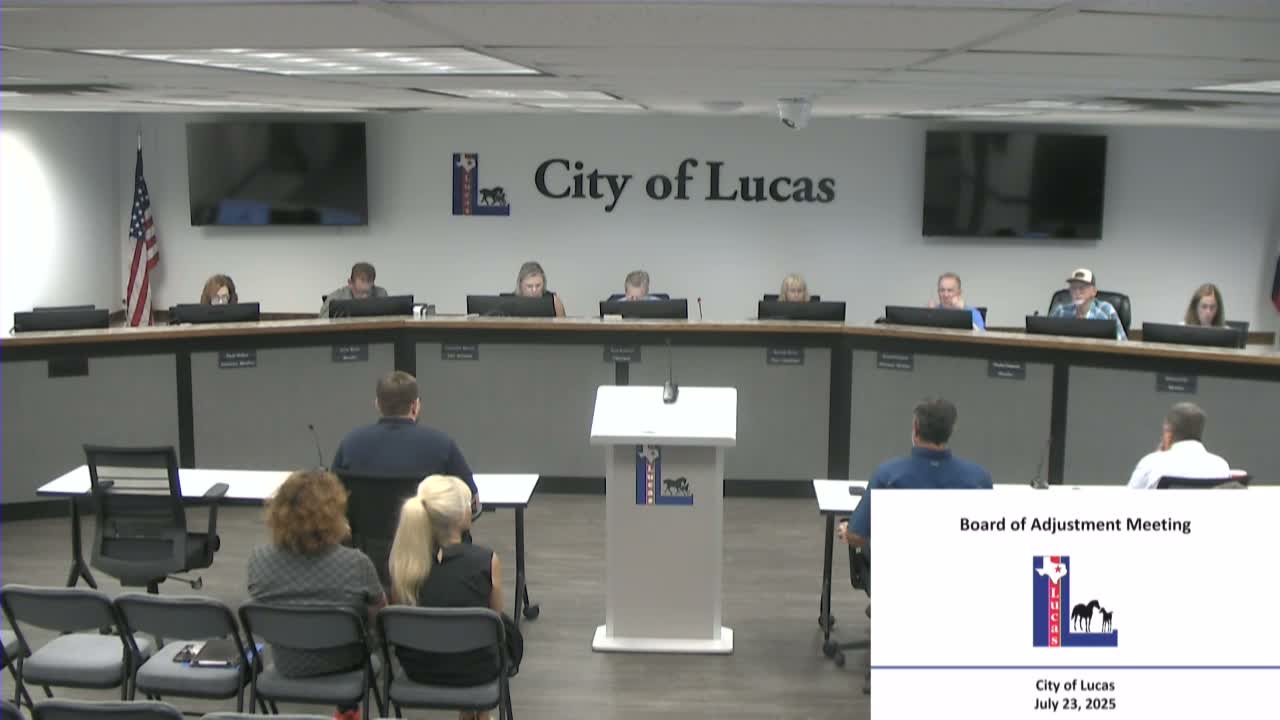
Lucas Board of Adjustments denies setback variance for 880 East Wenninghoff Road
Summary
After a staff report and applicant testimony, the Lucas Board of Adjustments voted to deny James and Ursula Dodd’s request to reduce front and rear yard setbacks for 880 East Wenninghoff Road, finding that on balance the board would not grant the requested reductions.
The Lucas Board of Adjustments voted to deny a request from James and Ursula Dodd to reduce front and rear yard setbacks for their property at 880 East Wenninghoff Road.
President Tom Redmond opened the public hearing at 6:34 p.m. and summarized the request: a reduction of the front-yard setback from 75 to 60 feet and the rear-yard setback from 50 to 30 feet under City of Lucas code chapter 14.03.0.113. A city staff presenter reviewed the staff report and told the board the lot predates the current ordinance and that, on paper, staff’s analysis indicated the variance criteria could be met. The staff presentation noted the existing site would yield a roughly 7,622-square-foot building pad without the variance and a 10,212-square-foot pad if the variance were granted, and that maximum impervious coverage for the lot is 35 percent of the parcel.
Applicant James Dodd said he and his wife, Ursula, recently purchased the 0.62-acre lot and are seeking flexibility to place a new house; he said the current setbacks leave about 65 percent of the parcel effectively unbuildable for the home they want. Dodd told the board he does not expect the proposed placement to harm neighbors and described the lot as a one-off situation that predates the ordinance.
A neighbor who said he owns surrounding property at 1905 Shady told the board he had seen the plan and did not object but asked how corner-lot setbacks would be applied where the parcel fronts two streets. Staff and the city manager clarified that setback measurements are taken from the road centerline and that street-facing side-yard rules can differ, noting that a side-yard facing a street can require a larger setback (staff cited 25 feet for side yards that face a street in one place during the discussion).
Board members debated whether the situation amounted to the legal hardship required for a variance. One board member said similar cases had been denied previously and suggested that because a purchaser generally knows existing restrictions the hardship could be considered self-imposed; city manager John Whittle relayed staff guidance that because the lot was established before the ordinance changed, the condition may not be self-imposed. Other board members emphasized adherence to the ordinance and concern about creating multiple one-off exceptions.
President Redmond moved to deny the request, formally stating the code section and the reductions sought. The motion was seconded and, after a voice vote in which four ayes were recorded, the board announced the variance request was denied. Redmond told the applicants they may appeal the board’s decision to district or county court within 10 days after the board’s decision is filed.
The board then returned to the regular agenda, approved the minutes from the May 28, 2025 meeting, and adjourned at 7:09 p.m.
Clarifying details drawn from the hearing: the staff presentation listed the front-yard requirement as 75 feet from the centerline for a Type C roadway and the rear-yard requirement as 50 feet; the applicant said the lot is about 0.62 acres and staff cited pad sizes of roughly 7,622 sq ft (without variance) and 10,212 sq ft (with variance); the packet referenced a potential 12-by-18 accessory structure that was not part of the variance request.