Get Full Government Meeting Transcripts, Videos, & Alerts Forever!
Get email alerts on the Tax Amnesty topic
No spam. Unsubscribe anytime.
Guam committee debates bill to codify tax-amnesty authority as officials warn of tradeoffs
Summary
Bill 2-31-38 would let the Department of Revenue and Taxation run rolling tax-amnesty programs that waive penalties and interest to recover unpaid principal. DRT told senators it has $245 million in receivables referred to collections (net), with about $158 million in underlying tax balances; senators pressed officials on staffing, past amnesty outcomes and risks to long-term collections.
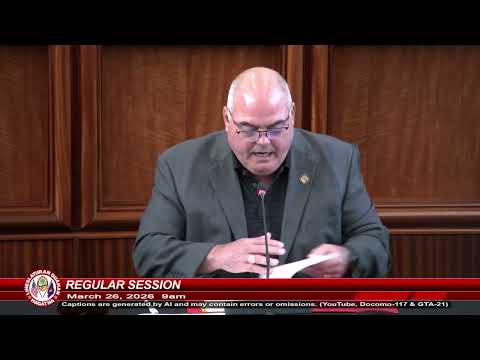
Guam’s Committee of the Whole heard Bill 2-31-38 on March 26, a measure that would add a statutory tax-amnesty authority to Title 11 and allow the Department of Revenue and Taxation (DRT) to run short-term programs waiving penalties and interest so delinquent taxpayers can pay principal.
Senator St. Augustine, sponsor of the bill, said the proposal ‘‘draws upon the lessons of [the] 2018 tax amnesty program’’ and aims to provide immediate liquidity for the government without raising taxes while helping struggling taxpayers resolve liabilities. "It provides immediate relief and revenue, supports struggling taxpayers, and strengthens our government ability to serve the people of Guam," the senator said in opening remarks.
Why it matters: DRT officials told senators the island has a net $245,000,000 of accounts receivable referred to collections (FY2025). Of that, DRT said roughly $158,000,000 is the unpaid tax principal, with about $54,000,000 in interest and $62,000,000 in penalties; administrative adjustments reduce the gross inventory by about $29,000,000. DRT also cited the 2018 amnesty, which the agency reported produced roughly $30,000,000 in payments when applications were accepted.
DRT’s tax-enforcement program administrator, Kjerilyn Rivera, emphasized operational limits. "Currently, we only have about 13 collection officers actively functioning," Rivera said, noting that limited staff and system constraints affect both ongoing collections and the work required to run a mass amnesty. Rivera also told the committee that 927 applications were processed during the 2018 program, of which 68.2% were approved and 432 were disapproved.
Supporters said the amnesty can generate near-term cash and help taxpayers reset obligations. Ranking Member Tina Rose Muñoz Barnes said past amnesties brought real revenue and argued the program could encourage taxpayers who have fallen behind to come forward.
Opponents and skeptical senators raised concerns that codifying a rolling amnesty could undermine compliance and reduce forecasted revenues. Senator Parkinson and others asked whether forgiving interest and penalties would simply shift revenue months earlier while reducing amounts the government otherwise collects over time. Director Edward Byrne of the Department of Administration said the administration does not oppose the bill but noted that budget forecasts are based on historical collections and that an amnesty exchanges future penalty/interest collections for immediate principal payments.
Staffing and design questions dominated the hearing. Senators pressed for: a tax-type breakdown of the AR (real property, BPT, income, tobacco/alcohol, gaming), a clear eligibility and timing window to avoid a perpetual expectation of forgiveness, and an estimate of administrative costs to operate an amnesty (software, overtime, outreach and additional personnel). DRT said program design choices (short window vs. rolling authority, eligibility exclusions) will materially affect costs and outcomes.
Noteworthy figures and claims: - Net accounts receivable referred to collections: ~$245,000,000 (FY2025), per DRT testimony. - Underlying tax balance (of that receivable): ~$158,000,000; interest ~$54,000,000; penalties ~$62,000,000; administrative adjustments ~$29,000,000. - DRT’s unaudited estimate that less than $10,000,000 of the AR may be uncollectable if collection efforts continue; agency cautioned that this depends on staffing and case complexity. - 2018 amnesty: roughly $30,000,000 collected; 927 applications processed (about 68.2% approved, 432 disapproved).
What’s next: Round 1 concluded without a vote. Senators requested a DRT breakdown of AR by tax type and taxpayer category and asked DOA/DRT to provide administrative-cost estimates in time for round 2 and amendment consideration. The committee recessed until 1:30 p.m. and will resume debate on related bills and proposals.
The hearing record shows persistent division: supporters point to demonstrated near-term collections and taxpayer relief; critics warn that codified, rolling amnesty could weaken long-term compliance and reduce net forecasted revenue absent strict eligibility and interagency coordination. No formal action was taken in round 1.