Get Full Government Meeting Transcripts, Videos, & Alerts Forever!
Get email alerts on the Education Schoolperformance topic
No spam. Unsubscribe anytime.
Preston High presenters cite IXL growth but warn math proficiency remains low as staffing cuts loom
Summary
Preston High School staff told the Preston County Board of Education that IXL benchmarks show growth for many students but math proficiency remains low; administrators outlined new discipline and attendance systems and warned that recent teacher reductions will force schedule and program cuts.
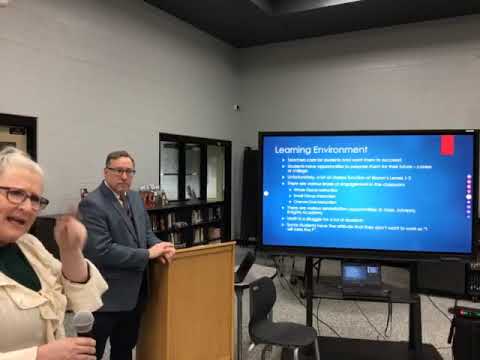
Preston High School leaders presented IXL benchmark results, discipline changes and attendance interventions on Feb. 9 as they respond to recent staffing reductions and plan schedule changes for next year.
At the school presentation, administrators said IXL—introduced this year as the district’s full‑year diagnostic—has produced growth for roughly 70% of students between the first and second benchmark. "Math is about 8%" proficient, the presenter said, and English proficiency was reported around 46%; presenters contrasted that to the state math proficiency rate, which they said is about 17%. School staff told the board the IXL platform provides individualized pathways and produces data that correlates more closely to SAT content than prior diagnostics, but several board members and student representatives cautioned against using a single benchmark as the sole determinant of course placement.
Administrators described instructional goals focused on higher‑order thinking (moving teachers and students up Bloom’s taxonomy), targeted advisory time for one‑on‑one instruction, and after‑school supports such as Knights Academy for remediation. The curriculum team said some teachers recorded very strong growth (examples cited in the presentation included large point gains for some teachers), while other classrooms showed negative growth, underscoring the school’s argument for combining multiple measures—grades, teacher recommendation and benchmark results—when making placement decisions.
Discipline and attendance were another major focus. The school has instituted daily behavior meetings that include administration, attendance staff and the school resource officer and is using the Weavish incident reporting system to manage and analyze incidents in real time. Staff said a recent increase in level‑one incidents was driven largely by cell‑phone violations (about 102 incidents in one grade cohort). They reported that when those cell‑phone incidents are removed from the totals, higher‑level incidents and suspensions are down from last year. The school’s cell‑phone protocol escalates consequences for repeated offenses and includes a parent‑student contract after multiple violations.
Attendance staff described a tiered MTSS attendance approach: universal supports at tier 1, targeted meetings and parent collaboration at tier 2 (for students with 8–10 unexcused absences), and referrals to probation or court processes at tier 3 when necessary. The presenters reported overall daily attendance rates in the low 92% range and said the district goal remains 95%.
Perhaps the most consequential operational note came in staffing and scheduling. Presenters said the district has cut about 22.5 teachers over three years and noted an additional roughly 9.5 teaching positions reduced this year; those reductions prompted school leaders to model both 7‑period and 8‑period day options for next year. "No matter whether we have seven or eight, we are going to lose electives," a presenter told the board, describing trade‑offs that could reduce opportunities for students to complete multiple career and technical education pathways. Administrators said they will run registration scenarios and share recommendations with families and the board.
Student board members asked for a dedicated agenda item at a future meeting to examine how IXL results would be used (or not) in placement decisions; administrators said placement typically uses multiple criteria and that school‑level protocols can be adjusted.
The presentation closed with requests for increased parent engagement and additional custodial and staffing resources; staff noted several operational constraints, including the number of custodians relative to building size and difficulties sourcing parts for older HVAC units.
The board did not take an action to change placement policy at the meeting; it requested further discussion and additional data from school administrators before any policy changes would be considered.