Get Full Government Meeting Transcripts, Videos, & Alerts Forever!
Get email alerts on the Water Safety topic
No spam. Unsubscribe anytime.
Officials: North Saint Paul water ‘safe to drink’ as chlorination and flushing continue
Summary
Public Works staff said the city is maintaining chlorination in coordination with the Minnesota Department of Health, will flush about 600 hydrants when weather allows, and advised residents on steps to clear brown water.
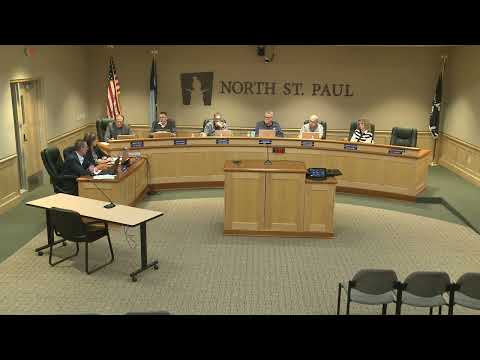
Ron, a Public Works staff member, briefed the council on the city’s ongoing response to late-November water test issues: the city is continuing temporary chlorination and coordinating with the Minnesota Department of Health and WSB engineers while preparing for a full system flush.
"The water is safe to drink, safe to use," Ron said when asked to address resident concerns. He explained that staff initially flushed to distribute chlorine, saw good tests, noted one subsequent bad test that prompted re-chlorination, and then saw good tests again after turning chlorine back on. He said staff will maintain residual chlorination until weather permits a full, system-wide flush and that flushing the roughly 600 hydrants could take two to three weeks with additional personnel assigned.
On chlorine levels, Ron referenced Minnesota Department of Health guidance that residual chlorine can range from 0.5 to 4 parts per million. He said daily samples show about 1.1 ppm at the city shop and about 0.11 ppm at a northern site near the Salvation Army, and reassured that those indicate the city is well below any over-chlorination thresholds. Ron acknowledged residents may detect a smell and explained that the odor often reflects system balancing as chlorine attaches to mineral sediments inside pipes.
For residents seeing brown or discolored water, Ron advised running an indoor tap (for example, in a laundry tub) for about 10 minutes; that clears it in the majority of calls. Staff offer to come out and flush individual service lines by removing the water meter, attaching a valve and hose, and running water to a drain or outdoors. He also suggested temporary point-of-use filters as an interim option and directed residents to the city website or Public Works for questions.
Council members thanked staff for outreach and noted the city newsletter will include updates as work continues. No changes to city policy were announced; staff said they will proceed with the chlorination and flushing plan and follow Minnesota Department of Health guidance.