Met Council outlines how 2023 sales tax reshaped regional transit funding
Loading...
Summary
Metropolitan Council Executive Director Charles Carlson briefed the Transportation Finance and Policy Committee on the evolution of regional transit governance and how the 2023 three‑quarter‑cent transportation sales tax replaced prior state and county operating supports, stabilizing an estimated structural deficit created by one‑time COVID and general‑fund fixes.
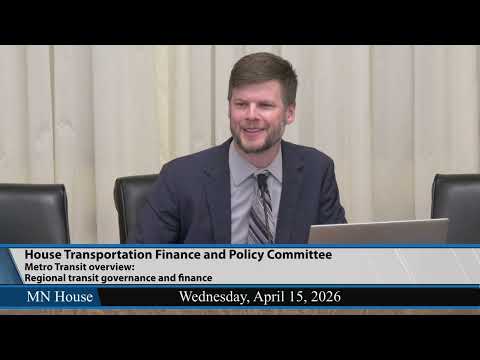
Charles Carlson, executive director of Metropolitan Transportation Services at the Metropolitan Council, told the Transportation Finance and Policy Committee on April 15 that the region’s transit funding model has shifted substantially since 2001 and was reshaped again by the 2023 Legislature.
Carlson summarized decades of change in governance and funding, noting that the region moved from fare‑ and property tax‑based support to a mix that relied on federal capital grants, state appropriations and — since 2001 — motor vehicle sales tax (MVST). “The 2023 legislature passed a new funding source, the region’s 3 quarter cent transportation sales tax that did important things,” Carlson said, describing the tax as the primary tool used to replace county transit‑way operating funds and to stabilize a looming structural operating deficit.
Why it matters: committee members pressed Carlson on the distributional effects of the funding shift and on substitutes for prior county and state support. Carlson said federal COVID relief (which provided “over $700,000,000” to transit) and one‑time state appropriations had temporarily masked a structural shortfall; the 2023 sales tax was intended to replace those on a durable basis.
Key details from the briefing included: the 2001 prohibition on using property tax for transit operations, the 2006 constitutional amendment that dedicated portions of MVST, and council policy (adopted 2018) that directs a modest share of regional MVST distributions to suburban “replacement service” providers. Carlson said the Council provides roughly 91% of service hours and more than 95% of ridership across the metro region; suburban providers account for about 4.5% of ridership and are estimated to receive about $90 million a year in combined distributions in 2026.
Members asked how opt‑out municipalities such as Maple Grove contract for service. Carlson said Maple Grove is a replacement service municipality that contracts portions of its express routes to Metro Transit, and that Maple Grove’s own fixed‑route service is a small share of the region’s total rides (about 0.5% of all rides). He agreed to provide follow‑up data requested by the committee, including five‑year ridership and service‑hour trends and a county‑by‑county breakdown of local option sales tax rates and balances.
Several committee members raised the question of whether county sales‑tax balances could be repurposed for nontransportation needs such as health‑care shortfalls. Counsel Burris told the committee that, under current law, the transportation sales tax revenues are dedicated to transportation categories and cannot be diverted without legislative change.
Carlson also described how the Council and TAB will allocate the new sales‑tax resources across transit operations, active transportation projects and other statutory priorities. He said TAB will publish solicitations for active‑transportation projects and that a portion of the sales tax is slated to grow markedly over the coming decade as the Transportation Advancement Account phases in.
The presentation was informational; no committee action was taken. Members left with follow‑up assignments: the Met Council agreed to provide additional data on ridership/service hours over time, more detail on suburban provider allocations and a clarification of county local‑option sales tax usages.