Lifetime Citizen Portal Access — AI Briefings, Alerts & Unlimited Follows
House committee adopts licensing changes but declines to advance childcare modernization bill
Loading...
Summary
The House Children and Families Finance and Policy Committee adopted a package of amendments to its childcare licensing modernization proposal but voted 5–7 against referring the amended House File 29 29 to Ways and Means, meaning the measure will not advance from the committee this year. Providers testified in favor of a provider board and changes to ease administrative burdens.
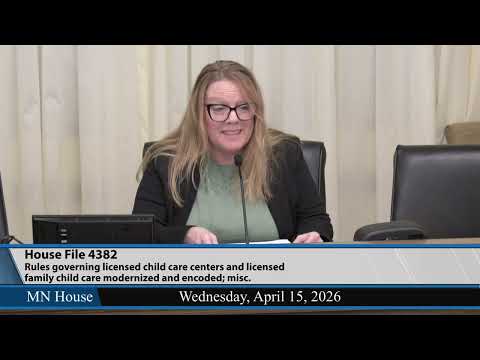
The House Children and Families Finance and Policy Committee on April 15 adopted a series of technical and programmatic amendments to its childcare licensing modernization proposal but stopped short of sending the amended bill to Ways and Means, effectively halting its progress this year.
Provider testimony opened the session. Shannon Richardson, a Duluth provider and CEO of five centers, told the committee the current licensing system “lacks consistency, is punitive, and has been broken,” and urged formation of a Minnesota Board for Early Care and Education to give providers “a voice at the table.” Lisa Thompson, the state ombuds for family childcare providers, urged caution and additional legislative fixes for family childcare, saying the proposed changes could reduce the declining number of family providers unless implemented with more input. Amy Wortzebach, preschool director at Dodge Nature Center and a member of Minnesota Early Childhood Outdoors, asked the committee to adopt narrow clarifications for nature-based programs, including clearer guidance on animal vaccination requirements.
Those public remarks set the tone for a lengthy amendment process. The committee considered a large technical minibus amendment (A4) that would have folded many previously heard bills into the modernization vehicle. Representative Hicks, who offered the A4, described it as a way to include bipartisan, previously vetted provisions ranging from extended foster care to foster-youth education priorities. Chair West and other proponents of a focused approach pushed back, arguing the committee should keep the vehicle narrowly centered on licensing modernization so the Senate would not view it as an omnibus package.
Several contested amendments were rejected. Roll-call votes defeated A4 (minibus omnibus), A5 (a CCAP absent-days exemption), A6 (a $1 million SNAP outreach appropriation) and A7 (a package of child-abuse prevention grants and programs). Vice Chair Hansen framed A7 as low-cost, evidence-based prevention investments; opponents argued the committee needed to prioritize modernization first.
The committee did adopt multiple provider-focused, technical amendments by voice vote. Those changes, described by lawmakers as aimed at reducing administrative burden while preserving health-and-safety protections, included:
- A10/A13/A14: changes for family childcare licensing, overnight-care language, sunscreen and mechanical-restraint clarifications, and nature-based program accommodations. - A9/A11/A12: allowing up to six licenses at a single contiguous location (instead of four), clarifying infant monitoring when electronic devices are used, and simplifying meal and training requirements. - A18: adjustments to family-care ratios, prorating training hours for employees out on PFML, aligning attendance-record retention with public funding requirements, and other operational clarifications.
Representative Coulter, the House author for the modernization effort, said some amendments represented “good stuff” that require additional fine-tuning but generally moved the policy forward. Chair West argued the package was “a massive leap forward” and repeatedly cited the high cost of childcare, saying the current system is unsustainable.
Despite the adopted amendments, the committee did not refer the bill. After adopting the DE2 amendment as amended by voice vote, members took a roll-call motion to forward House File 29 29 to the Ways and Means Committee. The clerk recorded five ayes and seven nays; the motion failed and the bill was not referred. The chair announced the amended H.F. 29 29 would not advance from this committee this year.
What happened next: Because the referral failed, the measure will not proceed through the committee’s usual path this session; sponsors said they hope to continue negotiations and consider the package again in the next legislative year. The committee chair and multiple lawmakers signaled they expect further work—particularly on family childcare issues—before any future advancement.
Votes at a glance - A4 (minibus omnibus): defeated (roll call; motion did not prevail) - A5 (CCAP absent-days exemption): defeated (roll call; motion did not prevail) - A6 (SNAP outreach $1,000,000): defeated (roll call; motion did not prevail) - A7 (forensic interview/crisis nursery/PSOP package): defeated (roll call; motion did not prevail) - A10, A13, A14, A9, A11, A12, A18: adopted (voice votes) - DE2 as amended: adopted (voice vote) - Final referral of House File 29 29 as amended to Ways and Means: failed, 5 ayes to 7 nays (roll call)
Key quotes “Licensing needs to exist. There needs to be means to hold providers accountable, and the system needs to reflect what is reasonable in the realm of working with children,” said Shannon Richardson, a provider who testified in favor of a provider board.
“This is right in front of us. If we are going to do anything, this is where we should invest,” Vice Chair Hansen said in urging adoption of prevention investments aimed at forensic interview training and crisis nurseries.
Chair West said the state’s childcare system is “a complete and utter disaster” and called passing modernization “a massive leap forward,” adding that the average cost for an infant can be about $20,000 a year in Minnesota.
Context and what to watch - Providers told the committee they want fewer paperwork burdens, clearer rules for nature-based programs and family-childcare-specific accommodations; sponsors adopted several targeted technical fixes in response. - The central procedural dispute was whether to use H.F. 29 29 as a narrow modernization vehicle or to fold in a broader set of previously heard bills. The committee split along strategic lines and did not reach a consensus by the end of the session. - Next steps depend on sponsors and leadership decisions; proponents said they will keep negotiating and may reintroduce or rework provisions next year.