Montgomery County committee advances 'Vehicle Recovery Act' to help families reclaim impounded cars
Loading...
Summary
County committees forwarded Expedited Bill 14-26, the Vehicle Recovery Act, to full council after debate over acceptable alternative documentation for non-owners to redeem impounded vehicles; staff emphasized operational safeguards and the need to balance property rights and family reunification.
Montgomery County joint committees recommended Expedited Bill 14-26 — billed in the packet as the Vehicle Recovery Act — to the full council after members and staff debated how to let non-owners quickly redeem impounded vehicles while preserving owner property rights and operational clarity for towing companies.
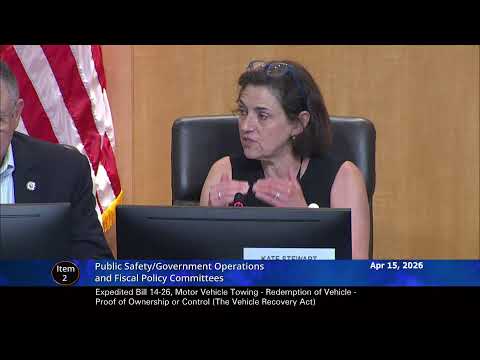
Chair Stewart said the bill grew from community input, including from We Are Casa, and concerns about vehicles left after federal immigration enforcement actions. "We saw the people being taken off our streets and their vehicles being left behind," Stewart said, describing situations in which impounded cars blocked hydrants or other public infrastructure.
Miss McCartney Green and council staff said the bill largely codifies existing executive regulations governing police tow release procedures and would expand the list of acceptable documentation for a non-owner to claim a vehicle. Under the packet language staff described, a non-owner could show a U.S. or state government ID, a foreign government ID, or a valid nonprofit ID plus one additional document demonstrating shared residence or familial relationship — examples cited included a utility bill, deed, mortgage statement, lease, marriage certificate, or birth certificate.
Council staff emphasized safeguards. They told members the amendment removes duplicate presumptions, clarifies proof of registration need not be limited to Maryland Motor Vehicle Administration documents, and adds a subsection allowing "other documentation as deemed sufficient" consistent with county regulations. Staff warned against lowering the documentation threshold so far that towing companies could release vehicles to the wrong person.
Office of Consumer Protection staff and county executive representatives answered operational questions. Sean Carrue, operations administrator at the Office of Consumer Protection, said private-tow rules currently allow towing up to 15 miles from point of origin and noted limited tow-lot availability; he and investigator Lorena Bailey urged careful drafting to avoid unexpected cross-jurisdictional complications. Dr. Stoddard of the county executive's office said police-directed tows typically go to a private lot and are transferred to the police tow lot, where county notifications and state-law processes occur. He urged clear regulatory guidance so tow-lot attendants are not forced to make difficult chain-of-custody judgments on the spot.
Council members pressed for clarity on familial relationships and operational practicality. Council member Lukey asked whether the person who eventually drives the vehicle off the lot must be a licensed driver; staff confirmed that requirement remains unchanged. Council member Mink recounted cases where detained individuals were the sole local household member and argued for flexible rules that still provide verifiable proof that a claimant has lawful possession or a close household relationship.
Staff presented technical edits recommended by the county attorney (clarifying registration documents and removing an automatic presumption that a non-owner is authorized) and suggested moving the bill language into a separate chapter that specifically governs police tow procedures rather than leaving it under chapter 30C.
With no objections to the agreed amendments, Chair Stewart called for a hand-raise to recommend the bill to full council; the chair said the recommendation was unanimous. The committee did not provide a roll-call tally in the transcript. The bill will proceed to full council for final consideration.