Bill would create task force to address rural veterans' mental health access in Minnesota
Loading...
Summary
Rep. Myers introduced HF 45‑88 to convene a task force examining barriers—distance, provider shortages, coordination gaps—and recommend solutions to improve rural veterans' access to mental health services. Testimony emphasized long travel times and workforce shortages; MDVA asked to refine scope and membership.
Representative Myers introduced House File 45‑88 on April 15, proposing a state‑level task force to identify and recommend fixes to barriers that prevent rural Minnesota veterans from accessing mental health care.
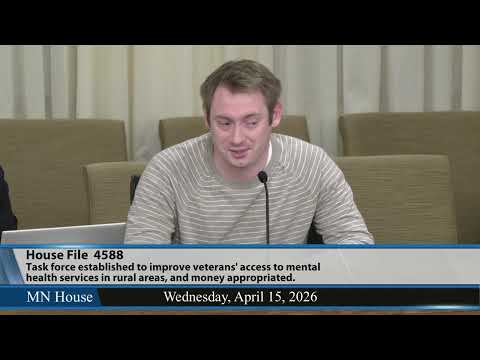
The bill, presented to the House Veterans and Military Affairs Division, aims to convene stakeholders around problems lawmakers and testifiers said persist across Greater Minnesota: long travel distances to care, provider shortages, transportation barriers and coordination gaps between local, state, federal and nonprofit systems. "A 3 to 4 hour drive for a veteran who's managing PTSD, substance use disorder, or depression is often the difference between getting care and not getting care," testified Bryce Wood, a third‑year clinical psychology doctoral student and eight‑year Air Force veteran.
Wood and other testifiers pointed to research and local experience. Wood summarized several findings: rural veterans are substantially less likely to receive mental health treatment and staffing shortfalls at VA facilities are linked to lower treatment initiation. He also gave state figures, saying Minnesota has nearly 296,000 veterans and that a higher share live in non‑metro areas compared with metro areas. Bridal Weed, another clinical psychology student, told the committee a local veteran clinic has a roughly 28‑day waiting period for intake, which she said can be damaging for people with acute conditions.
John Kelly, director of government affairs for the Minnesota Department of Veterans Affairs, said MDVA has held initial conversations with the bill author and wants to continue refining the bill’s scope. Kelly listed existing services—VA medical center systems, community‑based outpatient clinics, telehealth, Lutheran Social Services' state‑funded core program, vet centers and mobile vet centers—and said the department wants clarity on which specific gaps the task force would investigate before endorsing a commissioner‑led task force.
Members pressed for practical, data‑driven outcomes. Representative Clardy asked that demographic breakdowns be included in the task force duties so the group can identify which subpopulations are most affected. Representative Lee and others urged pulling wait‑time, driving‑distance and enrollment data to set a baseline and measure progress. Vice Chair Olsen urged using existing programs where possible and warned against a task force that merely studies problems without creating mandated coordination.
Representative Myers closed by describing the proposal as a structured way to gather stakeholders and produce informed recommendations for legislative action. The committee laid HF 45‑88 over for further consideration; no final vote on the bill itself was recorded at the hearing.
What’s next: Sponsors and MDVA said they will continue refining membership, scope and fiscal expectations; committee members asked for specific data pulls and clearer deliverables if the task force moves forward.