Get Full Government Meeting Transcripts, Videos, & Alerts Forever!
Get email alerts on the Security Officers Tiers topic
No spam. Unsubscribe anytime.
Panel adopts narrower DE to create five-tier framework for security officers; union and guards back the change
Summary
The committee adopted a DE3 amendment that narrows House File 4066 to establish five tiers for security officers and removed proposed training mandates; frontline officers and a union representative testified in support, saying tiers will clarify roles and start professionalization.
The House Committee on Public Safety Finance and Policy adopted an author amendment (DE3) to House File 4066 and laid the bill over as amended after testimony from security officers and a sponsor overview.
Representative Johnson explained DE3 narrows the bill to create five tiers for security officers or protective agents — Tier 1 (low‑risk access control and crowd management), Tier 2 (routine building security), Tier 3 (higher-risk unarmed roles where detention may be required), Tier 4 (armed security in high‑risk environments such as critical infrastructure and armored transport) and Tier 5 (armed security for individuals or groups). He said the DE3 directs license holders to attempt to place employees in the highest tier reflective of the work performed and removes prior training mandates to avoid immediate audit and staffing costs for the licensing board.
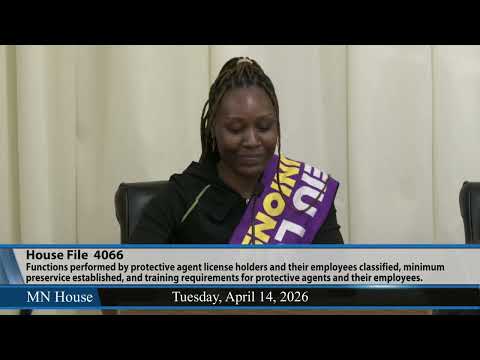
Jonelle Va, a security officer and union representative, testified that the industry needs clearer legal definitions so workers with the same title but different duties are recognized fairly. "Passing this bill is necessary first step to legally clarify the different levels of security guards," she said.
Deb Sievers, who identified herself as a security officer of seven years, said the bill would be an initial step toward professionalizing the work and later improving training. "This bill would be a first step towards us trying to professionalizing our critical work," she said, arguing clearer tiers would improve safety and job stability.
Members asked whether CPR or other training would be required; Representative Johnson and staff repeatedly clarified DE3 does not change current onboarding or continuing‑education requirements and whoever currently provides training would continue to do so. The DE3 amendment was adopted by voice vote and HF 4066 was laid over as amended.
The committee did not vote on the bill on the floor; the measure was advanced in committee to be considered later.